How to become a Project Manager in Australia: skills, salary and study pathways

Before a building rises, someone draws the first line. Before a product ships, someone maps the first step. And before any of it happens, someone has to hold the whole thing together, the people, the pressure, the decisions that don't wait.
That person is the Project Manager.
It's one of Australia's most in-demand roles, and one of the least understood from the outside. With around 19,000 Project Manager roles currently advertised nationally on SEEK, demand spans industries as varied as healthcare, technology, government, construction and professional services. A Project Manager coordinating a hospital digital rollout and one delivering a $500 million infrastructure project may share a job title, but the responsibilities, technical knowledge and salary expectations can be very different.
So whether you're already knee-deep in delivery work and wondering what comes next, eyeing a move into the role from another discipline or thinking about how study could sharpen your edge, this guide cuts through the noise. What the role actually involves. What it pays. And which pathways, from certification to postgraduate study, are worth your time.
A Project Manager plans, coordinates and leads projects from scope to delivery, managing timelines, budgets, risks and people along the way.
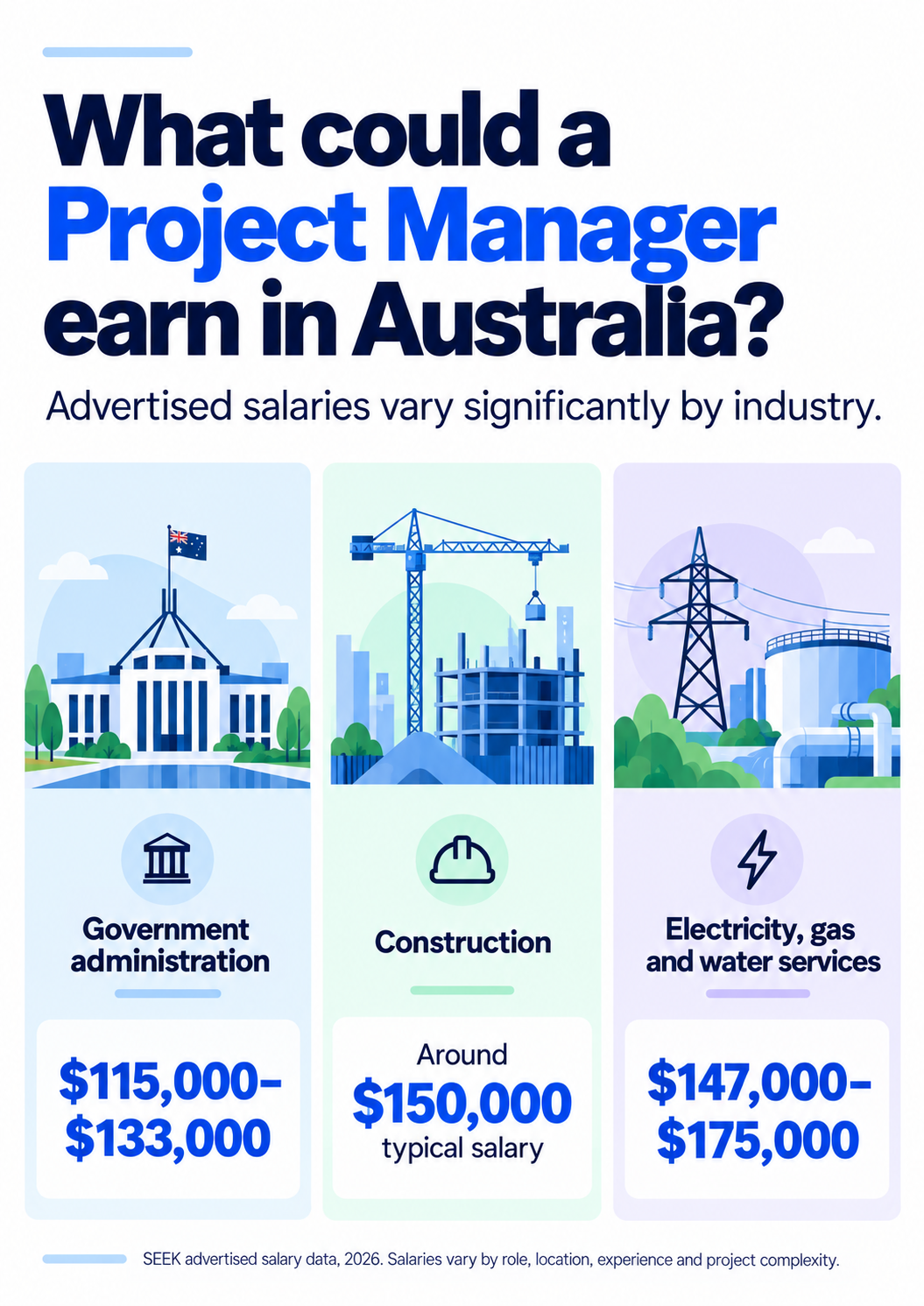
As at 2026, Project Manager salaries vary widely by industry and location. SEEK’s advertised salary data lists a typical construction Project Manager salary of around $150,000, with government roles generally lower and specialist sectors such as utilities higher.
You don't always need a degree to become a Project Manager, but experience, certification and postgraduate study each play different roles depending on your career stage.
Core skills include planning, stakeholder management, risk management, communication and adaptability — capabilities that only grow more important as project complexity increases.
An MBA won't make you a certified Project Manager, but it can build the broader business and leadership judgement needed to lead complex, high-stakes projects.
What does a Project Manager do?
A Project Manager plans, coordinates and leads projects from initial scope through to delivery, managing timelines, budgets, resources, risks and stakeholders along the way. Responsibilities shift depending on industry, but the core of the job stays the same: bringing people, priorities and resources together to deliver an agreed outcome.
Australia's current OSCA classification recognises project management across specialist occupations including Construction Project Managers and ICT Project Managers, reflecting how the role can vary significantly by industry and technical context. Construction Project Managers oversee engineering and building projects, while ICT Project Managers are responsible for coordinating technology projects, resources, schedules and delivery against agreed objectives and budgets.
What are the responsibilities of a Project Manager?
- Define project scope, objectives and deliverables
- Build project plans, schedules and budgets
- Coordinate people, resources and suppliers
- Manage risks, issues and dependencies
- Monitor progress, costs and quality
- Communicate with stakeholders and decision-makers
- Lead project teams
- Manage change throughout delivery
- Report on project performance
- Evaluate outcomes and close projects
These responsibilities closely mirror the new ABS classification — a sign of just how consistent the discipline has become across industries, even when the work itself looks completely different from one sector to the next.
What industries employ Project Managers?
"Project Manager" isn't one job. It's a title that stretches across almost every corner of the economy, including:
- Technology
- Professional services
- Government
- Health
- Financial services
- Construction and infrastructure
- Education
- Marketing and communications
- Transformation and organisational change
Australia's occupation classification reflects this by distinguishing between general Project Managers, ICT Project Managers and Construction Project Managers, because the technical context, qualifications and pay all differ. A Project Manager overseeing a hospital software rollout faces a different set of risks, tools and stakeholders than one delivering a highway upgrade — which is exactly why salary and study pathways aren't one-size-fits-all either.
How do you become a Project Manager in Australia?
There's no single door into project management. Most people don't plan their way in. They find themselves solving problems, coordinating teams or holding a deadline together, and somewhere along the way, the title catches up with who they've already become. Here's how that journey typically unfolds.
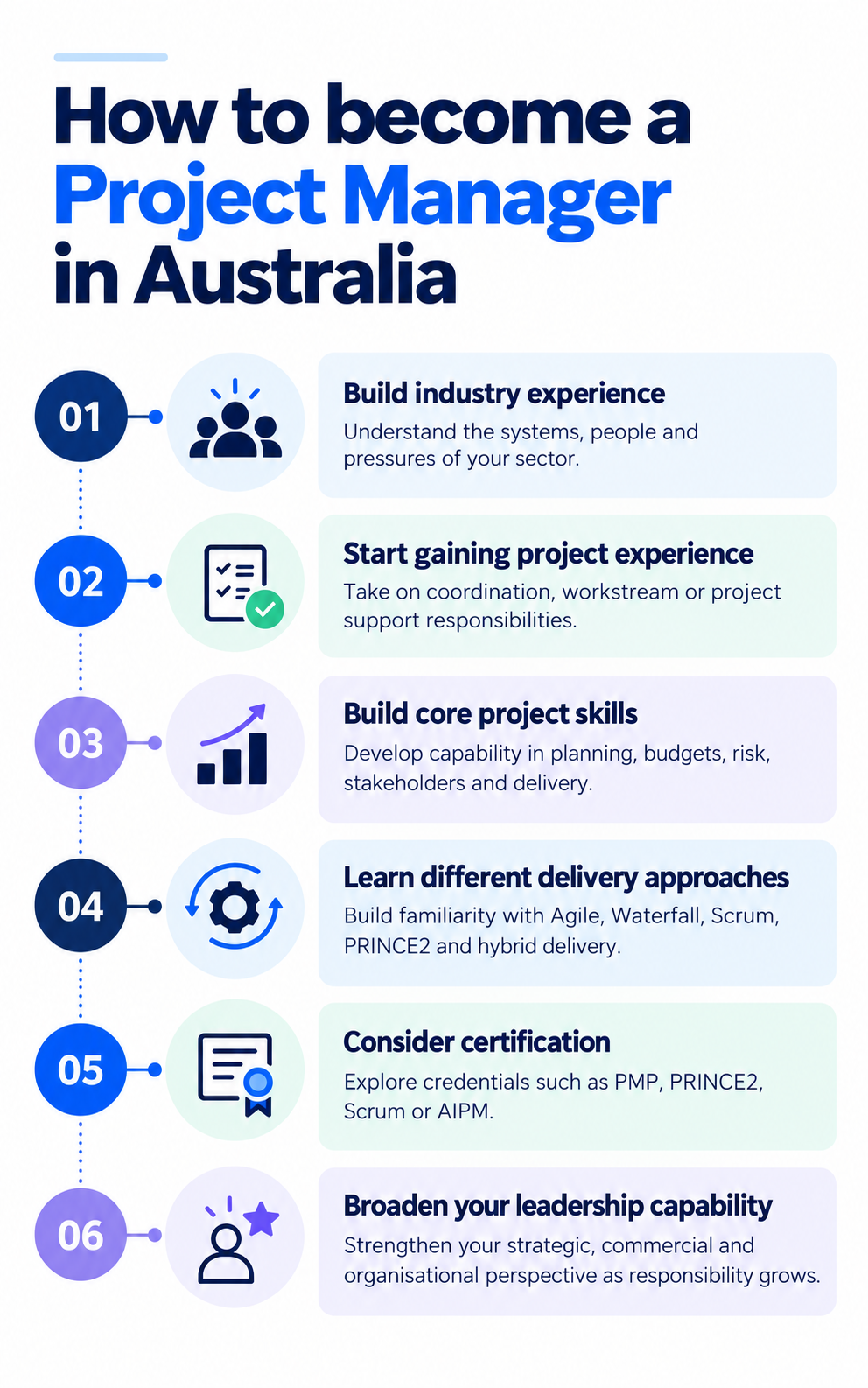
Step one: Build experience in your industry
Most people don't set out to become a Project Manager. They start somewhere else entirely: operations, technology, marketing, finance, healthcare, engineering, consulting, government or business transformation. Then one day they're the one holding the deadline, navigating the stakeholders, making the call. And slowly, the role finds them. What matters most in those early years isn't the title. It's the immersion: learning the systems, the people and the pressures that make your industry tick. That knowledge becomes the foundation everything else is built on.
Step two: Start building project experience
Before running an entire project, most professionals build experience through roles such as:
- Project Coordinator
- Project Officer
- Business Analyst
- Team Leader
- Operations Coordinator
- Change Coordinator
- PMO support
- Workstream lead
The new ABS classification identifies Project Coordinator as an alternative title for Program or Project Administrator — official confirmation of what most Project Managers already know from experience: coordination is where the craft begins.
Step three: Build core project management skills
This is the engine room of the role. Strong Project Managers develop capability across:
- Project planning - defining objectives, timelines, deliverables and resources
- Budget and resource management - balancing cost, people and priorities
- Risk management - spotting what could derail delivery, early enough to act
- Stakeholder management - navigating competing priorities while keeping everyone informed
- Communication - turning complex project detail into clear decisions
- Leadership - creating clarity and momentum when a team hits friction
- Decision-making - weighing evidence against time, cost, risk and priorities
- Adaptability - knowing when to hold the plan and when to change it
Project management is built on structure. But delivery? Delivery is built on judgment. The best Project Managers aren't the ones who never deviate from the plan. They're the ones who read the room, weigh the risk and know exactly when changing course is the smartest move of all.
Step four: Learn common project management approaches
Organisations lean on different delivery frameworks depending on the nature of the work — Agile, Waterfall, hybrid delivery, Scrum, Lean, PRINCE2 and PMBOK-based approaches all show up across Australian workplaces. No single methodology wins every time. What matters more than loyalty to a framework is the ability to move between them as the work demands.
Step five: Consider professional certification
Certifications like PMP, PRINCE2, Agile certifications and AIPM credentials can demonstrate familiarity with a specific project management framework or professional standard. They're valuable, but they serve a different purpose than postgraduate study. Certification builds depth in method. Postgraduate business study builds breadth — across strategy, leadership, finance, technology and organisational decision-making.
| Certification | What it focuses on | Best suited to |
| PMP (Project Management Professional) | Broad project leadership across predictive, hybrid and agile ways of working, with a focus on people, processes and business outcomes. | Experienced project professionals looking for a globally recognised credential. |
| PRINCE2 Project Management | A structured project management method covering principles, practices, processes, roles and responsibilities. | Professionals working in organisations that use PRINCE2 or who want a clearly defined project delivery framework. |
| Certified ScrumMaster (CSM) | Scrum principles, team facilitation and agile ways of working. | Professionals working in agile or Scrum environments, including aspiring Scrum Masters and Project Managers. |
| AIPM RegPM | Recognition of project management capability and experience against Australian professional standards. | Project professionals looking for an Australian industry credential aligned to their level of experience. |
The right certification depends on your experience, industry and the way projects are delivered in your organisation. Certification can strengthen your capability in particular methods or professional standards, while postgraduate business study can help broaden your perspective across strategy, leadership, finance, technology and organisational decision-making.
Step six: Build broader leadership and business capability
As projects grow larger and more strategic, so does the job. Senior Project Managers need to understand organisational strategy, commercial priorities, governance, technology, stakeholder politics, people leadership, sustainability and business value — not just schedules and budgets. This is the point where many professionals start looking at postgraduate study, not to learn project management from scratch, but to sharpen the judgement that comes with bigger responsibility.
What skills does a Project Manager need?
Beyond the fundamentals, employers increasingly look for:
- Negotiation
- Problem-solving
- Strategic thinking
- Data-informed decision-making
- Change management
- Digital and AI capability
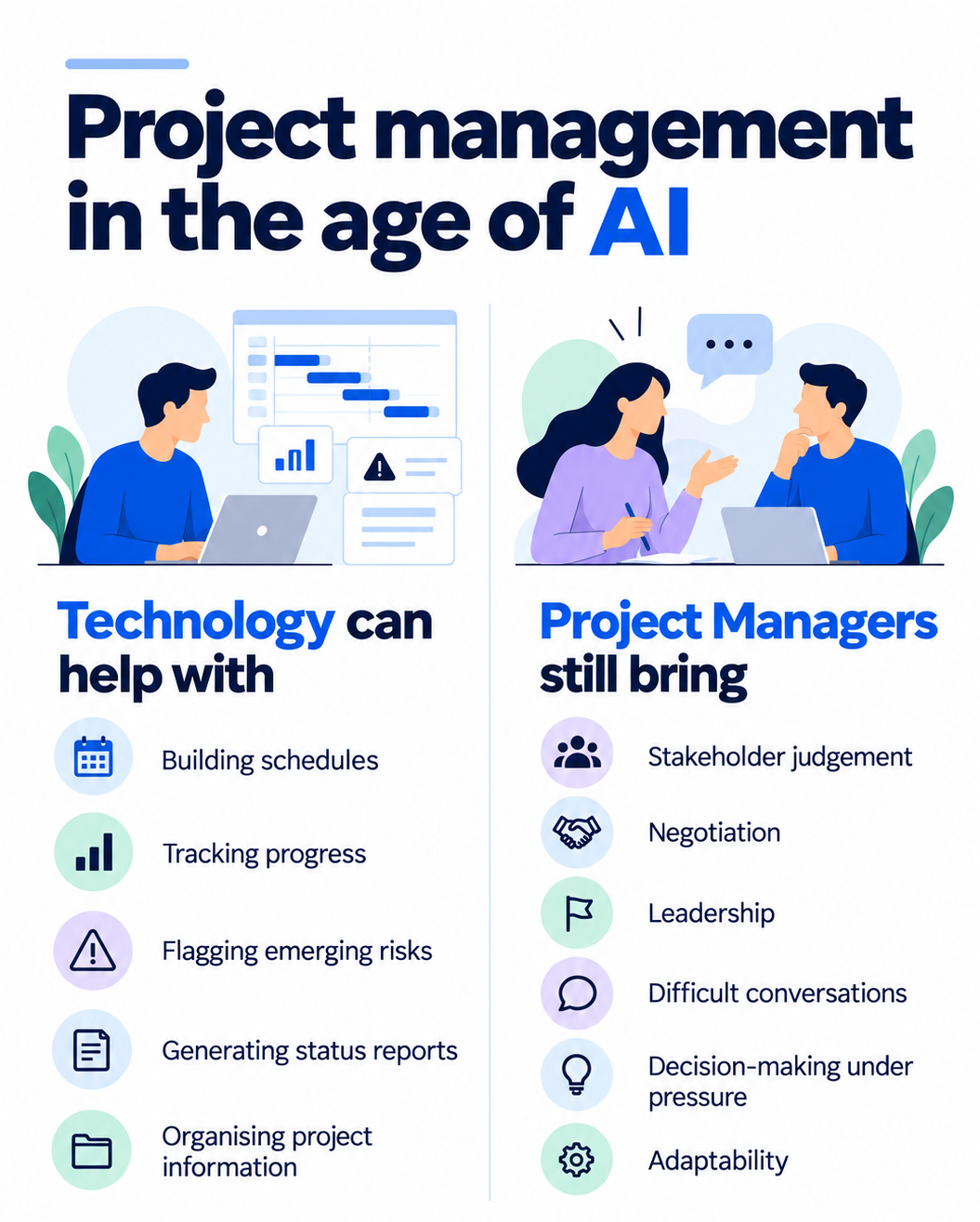
AI and automation are changing how projects are delivered. Tools can now help build schedules, flag emerging risks, track progress and generate status reports with far less manual effort. But software still can’t read a room. It can’t defuse a tense stakeholder conversation, make a judgement call under pressure or rally a team when the plan falls apart. As more of the administrative work becomes automated, human leadership becomes even more important to successful project delivery.
What is the average Project Manager salary in Australia?
There's no single, universal number here — and any article that gives you one isn't being straight with you. Project Manager salaries in Australia vary significantly depending on industry, location, experience and project complexity.
SEEK currently lists a typical Project Manager salary of around $150,000 in its construction career data, while advertised salaries shift considerably by sector. SEEK's current estimates put Project Manager salaries around $115,000–$133,000 in government administration, compared with $147,000–$175,000 in electricity, gas and water services.
These figures are based on advertised salary data and industry estimates. Treat them as a guide, not a guarantee.
What affects a Project Manager's salary?
- Industry
- Project size and complexity
- Experience
- Seniority
- Location
- Technical expertise
- Professional certification
- Budget responsibility
- People leadership
- Program or portfolio responsibility
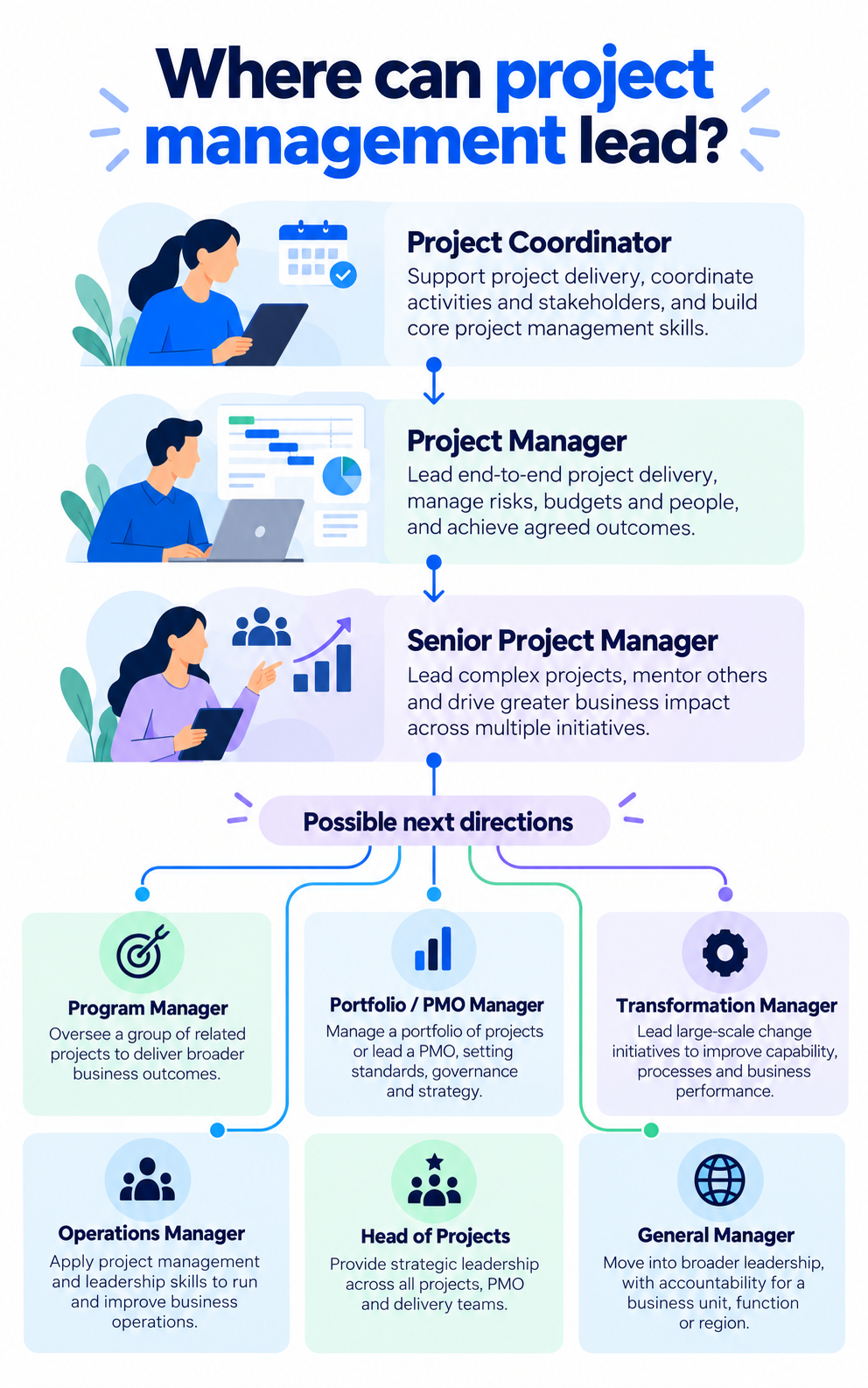
Progression typically moves from Project Coordinator to Project Manager, then Senior Project Manager, Program Manager, and eventually Portfolio or PMO leadership — with pay generally rising alongside the scale and risk of what you're responsible for delivering.
Is project management in demand in Australia?
Project management sits at the centre of nearly every industry in Australia. Technology, government, professional services, construction and health all run on it. In ICT alone, Jobs and Skills Australia's latest ANZSCO data recorded around 49,600 ICT Project Managers. That's just one specialist field. One slice of a much bigger picture.
Digital transformation, infrastructure investment and the relentless pace of organisational change have created a profession that doesn't slow down. Project management keeps finding new ground, new industries and new ways to matter. This isn't a role the future is leaving behind. It's one the future keeps reaching for.
Do you need a degree to become a Project Manager?
Not always. Pathways vary by industry — experience, sector expertise and professional certification can all carry real weight. Some specialist roles set a higher bar: the ABS classifies Construction Project Manager as a Skill Level 1 occupation, generally associated with a bachelor degree, higher qualification or substantial relevant experience.
For experienced professionals, postgraduate study tends to matter most when the goal shifts from delivering projects to leading through them — moving beyond delivery into transformation, strategy or broader organisational responsibility.
Do you need a Master of Project Management?
No single postgraduate qualification is required for every Project Manager role. A specialist Master of Project Management may suit professionals who want deep, focused study in project methodology. An MBA offers something different — combining project leadership with broader capability across strategy, finance, people, technology and organisational decision-making.
Can an MBA help you become a Project Manager?
An MBA won't make you a certified Project Manager, and it's not a substitute for professional project management certification. What it can do is help experienced professionals understand the wider business context their projects sit inside — the strategic trade-offs, financial pressures and organisational politics that shape whether a "successful" project actually creates value.
The UTS Online Master of Business Administration (MBA) develops capability across strategy, leadership, AI-enabled decision-making, innovation, ethics and sustainability — helping professionals look past the project plan to the decisions behind it. The course connects theory to contemporary business challenges through practical, applied learning, with career-relevant study across Digital Marketing, Health, Organisational Learning, Technology Management and Flex pathways, alongside its core business curriculum.
Through the Project Leadership elective, students can explore how to lead complex projects, navigate competing stakeholders and connect delivery back to broader organisational goals — building on technical project skills rather than replacing them.
How does project leadership fit into the UTS Online MBA?
As Project Managers progress, the nature of the challenge tends to change. Scope, schedule and risk still matter — but greater seniority brings harder questions about people, strategy, negotiation, governance and organisational change. That's the gap an MBA is built to close, through subjects like Leading People and Change, Data Driven Decision-Making, Governance and Sustainability, Financial Fundamentals, Strategy and Negotiation, and the Project Leadership elective itself.
Where can a project management career lead?
- Project Coordinator
- Project Manager
- Senior Project Manager
- Program Manager
- Portfolio Manager
- PMO Manager
- Transformation Manager
- Operations Manager
- Head of Projects
- General Manager
Where any individual career actually lands depends on industry, experience and the scale of responsibility taken on along the way — there's no fixed ladder, just a general direction of travel.
Lead projects with a broader view
The best Project Managers don't just deliver work. They shape outcomes, influence decisions and move organisations forward. Getting there takes more than a methodology. It takes the kind of judgement, leadership and business fluency that only comes with stretching beyond the plan.
The UTS Online Master of Business Administration (MBA) is built for professionals who are ready to lead at a higher level. It develops the strategic judgement, financial fluency, leadership capability and AI-enabled thinking that complex projects and organisations demand. Every subject connects back to the real decisions you're already facing at work, so you're not just building knowledge. You're building the edge that moves careers forward.
Ready to lead at a higher level? Explore the UTS Online Master of Business Administration (MBA) or call a Student Enrolment Advisors on 1300 477 423 to find the right next step for you.
Frequently asked questions
Project Manager salaries vary by industry and location. SEEK lists a typical construction Project Manager salary around $150,000 on average, while government roles often sit between $115,000–$133,000 and specialist sectors like utilities can exceed $170,000. These figures are estimates, not guarantees.
Most professionals build industry experience, move through coordination or support roles, develop core project skills, learn common delivery frameworks, and consider certification or postgraduate study as responsibility grows.
Requirements vary by sector. Some roles, like Construction Project Manager, are typically associated with a bachelor degree or substantial relevant experience. Many general Project Manager roles prioritise experience and certification over a specific degree.
Core skills include project planning, budget and resource management, risk management, stakeholder management, communication, leadership, decision-making and adaptability.
Yes, in many industries. Experience, sector expertise and professional certifications like PMP or PRINCE2 can be enough to move into the role, particularly outside specialist technical fields.
No. A Master of Project Management can offer deep, specialist study in project methodology, but it isn't a requirement. Other postgraduate options, like an MBA, build broader business and leadership capability instead.
An MBA isn't a professional project management qualification, but it can build the strategic, financial and leadership judgement needed as Project Managers move into more senior, cross-functional roles.
A Project Manager typically leads a single project through to delivery. A Program Manager oversees multiple related projects, coordinating them toward a broader strategic outcome.
Technology, government, professional services, health, financial services, construction, education, marketing and organisational transformation all employ Project Managers, though the specific skills and pay can differ considerably by sector.
There's no fixed timeline. Many professionals spend several years building experience in coordination or support roles before stepping into a full Project Manager title, with progression depending on industry, opportunity and demonstrated capability.