How to become an urban planner in Australia: 7 steps to get started
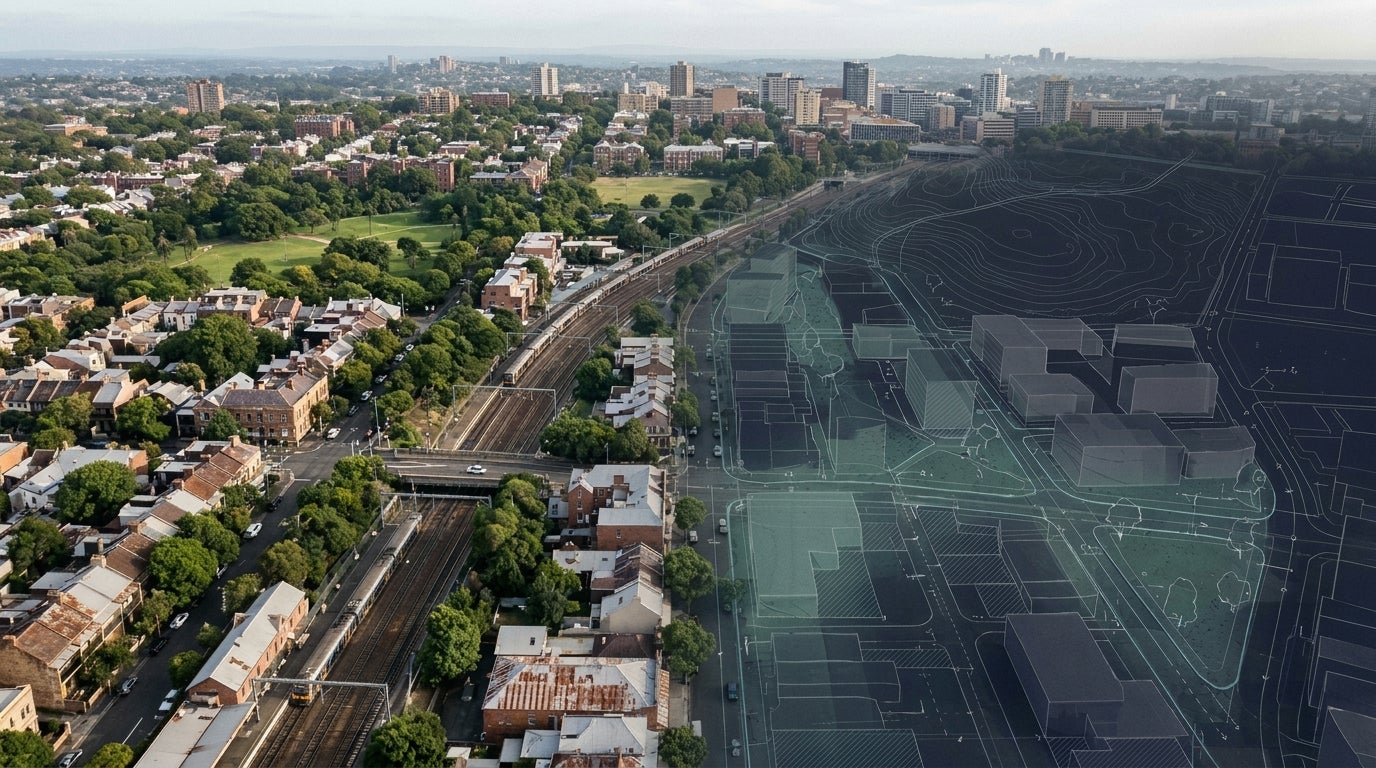
Australia's cities are changing fast. Sydney, Melbourne, Brisbane and Perth are reshaping their skylines, expanding transit networks and grappling with housing affordability, climate resilience and liveability challenges that require skilled, informed decision-making. Behind every new transit corridor, flood-resilient suburb or revitalised neighbourhood precinct, there's an urban planner.
If you're wondering how to become an urban planner in Australia, you're likely already closer than you think. Many people drawn to planning come from architecture, environmental science, government policy, geography or property, and already hold skills that translate directly into the profession. This guide breaks down what urban planners do, what qualifications matter in the Australian context, how Planning Institute of Australia (PIA) accreditation and membership work, and the step-by-step career path from where you are now to where you want to be.
What you need to know
Australia's growing population is placing increasing pressure on cities and regions to plan for sustainable development, infrastructure and more liveable communities. According to the Australian Bureau of Statistics, the population reached approximately 27.9 million in March 2026, highlighting the importance of effective urban and regional planning.
Jobs and Skills Australia reports that approximately 18,800 urban and regional planners were employed nationally as of February 2026, working across government, consultancy, property development and environmental planning. As Australian communities continue to grow and evolve, urban planners have an important role in shaping how we live, work and connect.
The path into urban planning typically looks like this:
- Completing a PIA-accredited qualification at undergraduate or postgraduate level
- Building practical skills in GIS, planning law, community engagement and sustainable development
- Gaining relevant work experience across local or state government, consultancies or related industries
- Pursuing PIA membership to access professional networks, credibility and career development
- Applying for planning roles that match your specialisation and experience
It's worth noting that there's no single national licensing requirement to work as a planner in Australia. PIA membership is not compulsory, but it's widely recognised and respected by Australian employers. For career changers with a related background, a postgraduate planning qualification is usually the most direct route into the profession.
Urban planning in Australia spans land-use policy, sustainability, community engagement and economic development. Professionals from many backgrounds can transition into the field.
PIA recommends completing a PIA-accredited planning course as the clearest pathway into the profession.
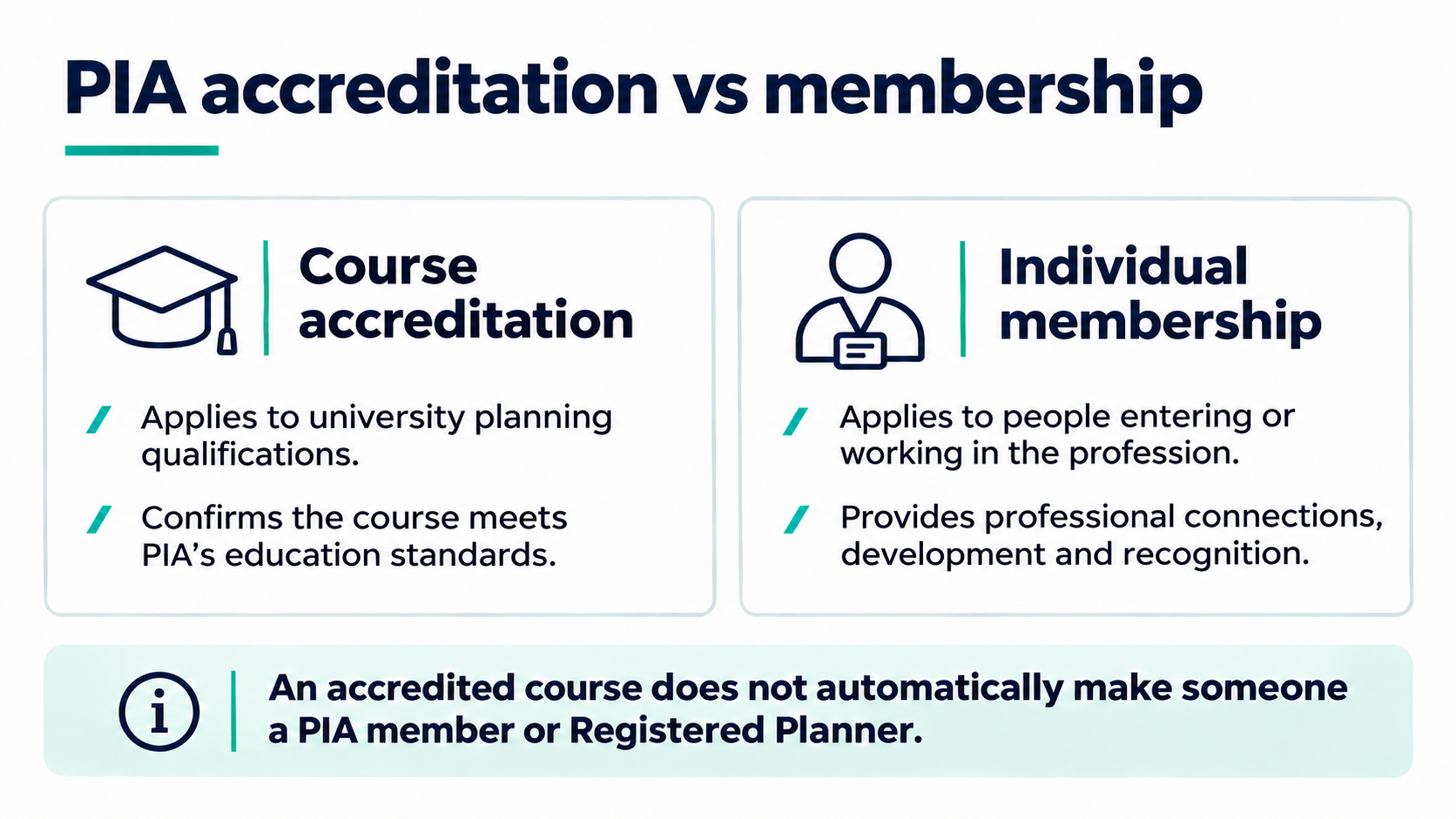
PIA accreditation applies to university planning courses, while individual membership supports professional development and recognition. Membership is not compulsory to work as an urban planner.
There's no single national licensing requirement to work as an urban planner in Australia, though some states run separate recognition schemes.
A postgraduate qualification, such as a Master of Urban Planning, is a realistic pathway for career changers with a related undergraduate degree or relevant professional experience.
What does an urban planner do in Australia?
Urban planners decide how land is used, how communities grow and how competing priorities, including housing, transport, environment, heritage and economic development, are balanced over time. According to PIA, planning is "how people, businesses and government protect, grow and shape cities, towns and regions," with planners weighing built and natural environments against community needs, cultural significance and economic sustainability (planning.org.au).
In practice, Australian urban planners:
- Assess development applications against local zoning rules and planning legislation
- Recommend rezoning near train stations to support higher-density housing
- Develop flood-risk planning controls for growth corridors
- Run community consultation sessions before councils adopt local strategic plans
- Write policy that balances heritage protection with infill development
PIA recognises a wide range of planning specialisations, including urban development, regional and rural planning, development assessment, social and community planning, urban design and place-making, environmental planning and natural resource management, transport planning, heritage and conservation, neighbourhood renewal, infrastructure planning and international development (planning.org.au).
Urban planning vs urban design: what's the difference?
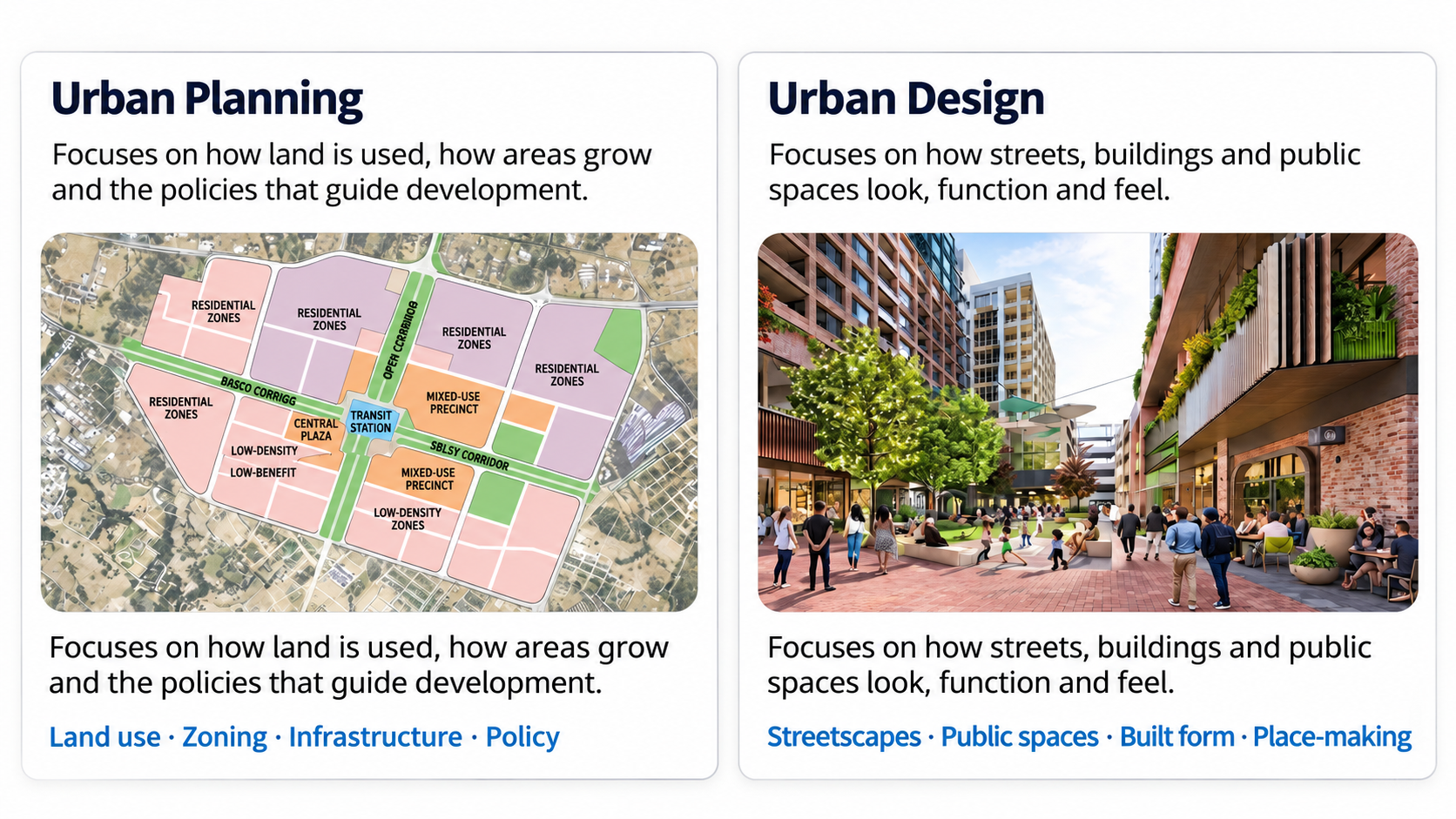
Urban planning focuses on policy, land use and the strategic direction of how an area develops, including zoning, infrastructure sequencing, growth management and regulatory frameworks. Urban design is more concerned with the physical quality and experience of places: how a street feels to walk down, how a public square functions, how buildings relate to each other.
The two disciplines overlap constantly. A planner might set the policy framework that enables a mixed-use precinct; an urban designer shapes what that precinct looks and feels like on the ground. Many practitioners move across both fields throughout their careers.
Where do urban planners work in Australia?
Australian planners work across local, state and federal government, private planning consultancies, property development companies, environmental consulting firms, infrastructure agencies and university research and teaching roles (planning.org.au). Some specialise in statutory work, processing and assessing development applications, while others focus on strategic, policy-driven planning that shapes an area over the next decade or more.
How to become an urban planner in Australia: a step-by-step career roadmap
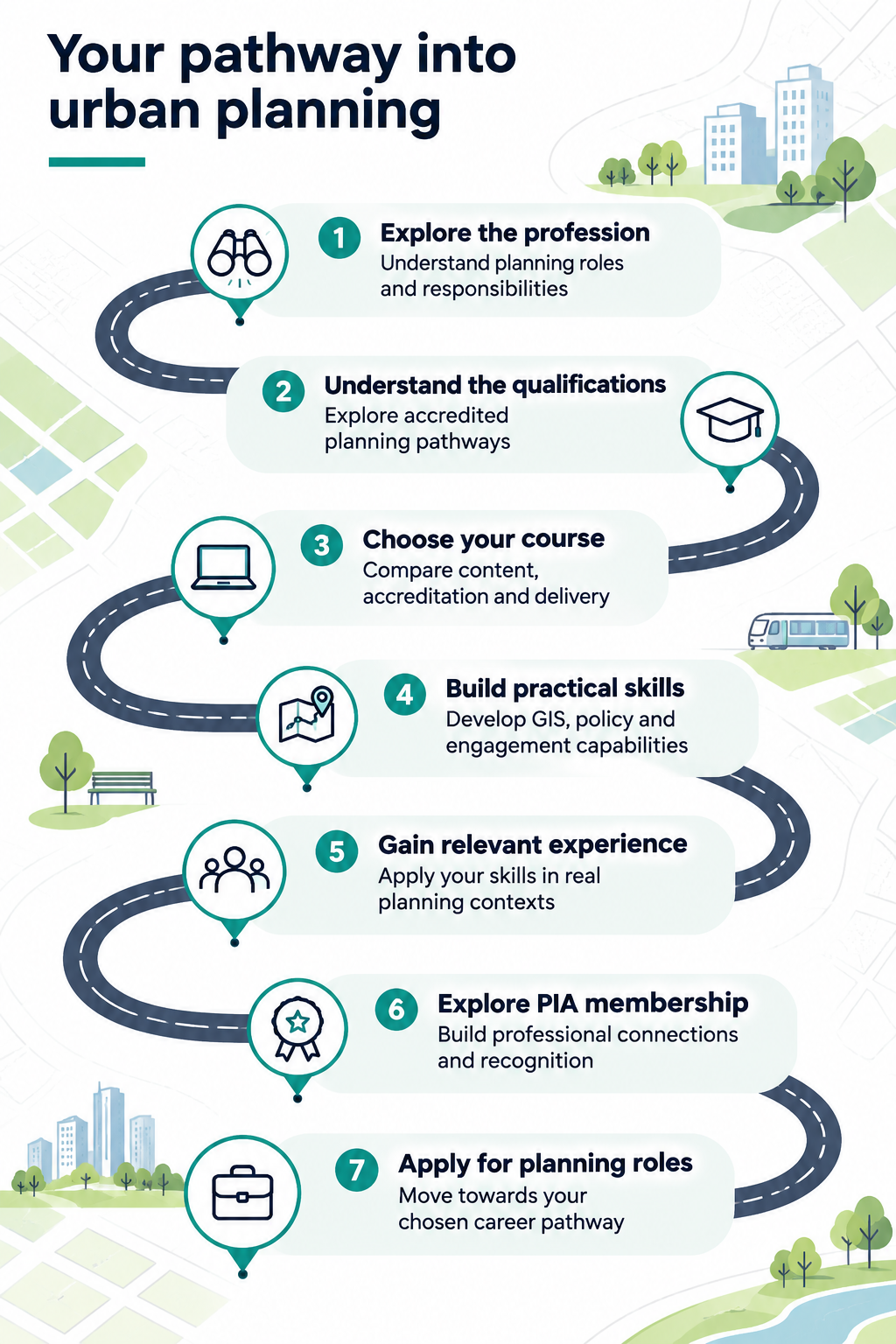
Here's the short version: explore the profession, choose and complete a relevant qualification (ideally PIA-accredited), build practical skills, gain hands-on experience, pursue PIA membership and apply for planning roles that match your strengths. Each step, including where PIA membership fits in, is unpacked below.
Step 1: Explore the urban planning profession in Australia
Before committing to study or a career shift, spend time understanding what planners actually do day to day. Read entry-level planning job advertisements on Seek or LinkedIn to see what Australian employers expect. Typical listings mention development assessment, policy writing, Geographic Information Systems (GIS), which are used to map and analyse spatial data, and stakeholder engagement. If you're coming from architecture, geography, environmental management, construction or government policy, map your existing skills against these requirements. You may already have more transferable experience than you realise.
Step 2: Understand what qualifications you need
Most people entering urban planning in Australia complete either an undergraduate planning degree or a postgraduate planning qualification. PIA "highly recommends completing an accredited planning course as the easiest means to get the skills you need to enter the planning profession" (planning.org.au).
If you already hold a degree in a related field, such as architecture, environmental science, geography, construction, engineering or property, a postgraduate planning qualification can build planning-specific knowledge without requiring you to start from scratch.
Step 3: Choose the right urban planning course for your situation
When comparing Australian urban planning courses, look for:
- PIA accreditation status — accreditation runs on a five-year rolling cycle, so always check the listed expiry date on PIA's accredited courses page before enrolling
- Course content — including planning law, spatial analysis, sustainable development and community engagement
- Delivery mode — especially if you're planning to study while working full-time
- Practical learning — such as projects based on real Australian planning scenarios
- Entry requirements — particularly if you're applying with a related but non-planning undergraduate degree
For career changers, postgraduate study is often the most direct pathway. It builds planning expertise on top of an existing qualification rather than requiring a full undergraduate degree.
Step 4: Build the practical skills urban planning employers want
Planning courses and early career roles typically develop capability across:
- GIS and spatial analysis — mapping and interpreting land-use data for Australian planning contexts
- Policy interpretation — reading and applying Australian planning schemes and legislation
- Research and strategic planning — forecasting population growth and infrastructure needs
- Community engagement — running consultations and interpreting public feedback
- Sustainability assessment — weighing environmental impact against development goals
- Report writing — producing clear, defensible planning recommendations
These aren't abstract skills. A planner assessing a development near a flood-prone creek draws on spatial analysis, environmental law knowledge and report writing simultaneously to produce a recommendation that holds up to scrutiny.
Step 5: Gain relevant experience in an Australian planning context
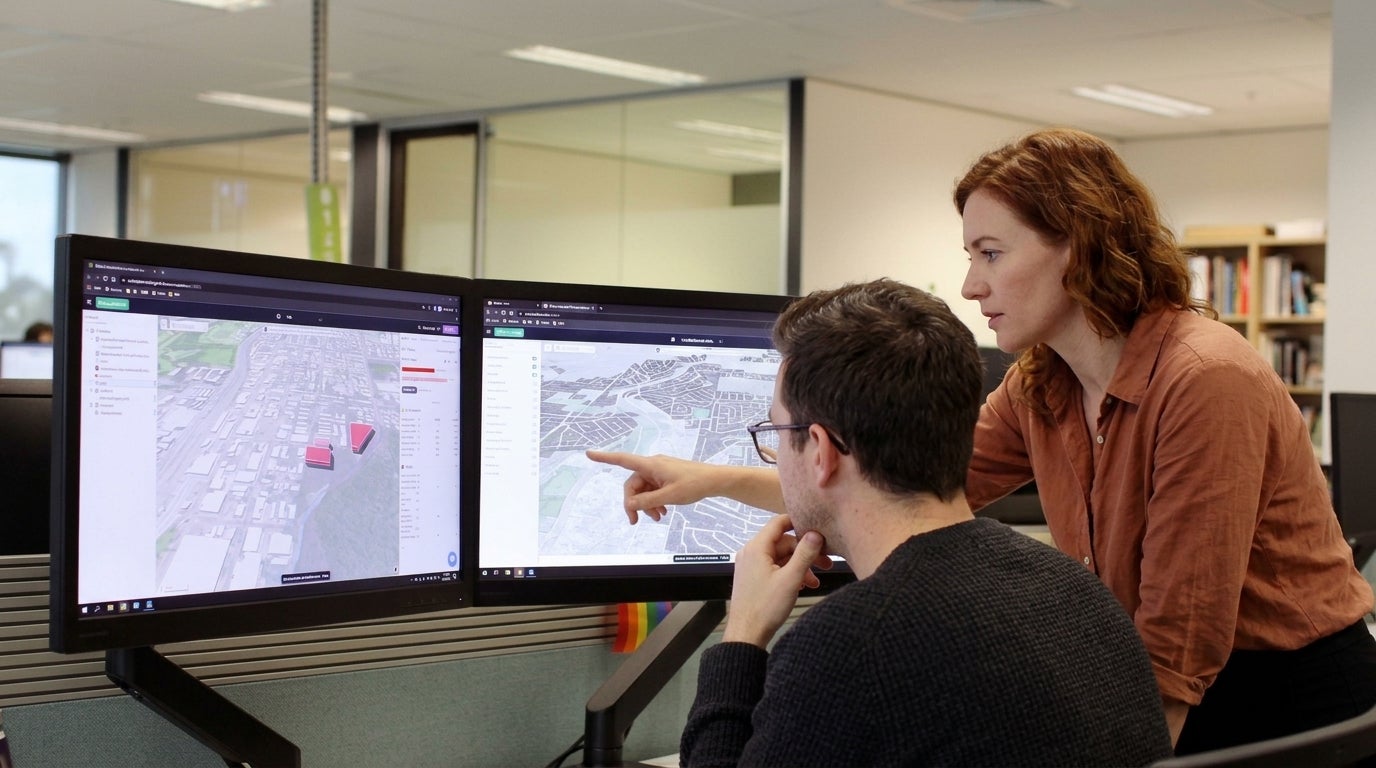
Experience can come from graduate roles in local or state government, development assessment positions, planning support roles or broader project and policy work. Opportunities to contribute to strategic planning, community engagement, place-making and spatial analysis can also help you develop practical skills and a stronger understanding of the profession.
If you're changing careers, don't overlook the experience you've already built. Skills developed through construction, architecture, environmental science, property or government policy can provide a valuable starting point for a career in urban planning.
Read on to discover how you can become an urban planner without a planning degree, and how your existing qualifications and professional experience could translate into a planning role.
Step 6: Explore PIA membership and professional development
While PIA membership isn't required to work as an urban planner in Australia, it can help you build professional connections, access development opportunities and gain recognition as your career progresses.
PIA offers membership options for students, graduates and experienced professionals, including Full Member and Registered Planner recognition for those who meet the relevant criteria. Eligibility depends on your qualifications, professional experience and, for some membership categories, competency assessments.
Explore the Planning Institute of Australia's membership options and eligibility requirements to find the pathway that aligns with your experience.
Step 7: Apply for urban planning jobs in Australia
Look for entry-level titles such as Graduate Planner, Planning Officer or Assistant Development Assessment Officer. When applying, connect your experience to real Australian planning challenges rather than leaning solely on your qualification. Talk about a rezoning project you contributed to, a stakeholder consultation you supported or a GIS analysis you completed during study. Employers want evidence you can apply planning thinking to actual places, not just describe planning theory.
What qualifications do you need to become an urban planner in Australia?
| Pathway | Who it may suit | Key considerations |
| Undergraduate planning degree | People beginning their tertiary studies | Check PIA accreditation; seek practical placement opportunities |
| Postgraduate planning qualification | Graduates and career changers with a related or unrelated first degree | Entry criteria vary by university; confirm current accreditation status |
| Related degree plus relevant experience | Professionals from adjacent fields (architecture, environmental science, geography) | Employer expectations vary; additional planning-specific study may still help |
| Graduate Certificate pathway | Professionals testing postgraduate planning before committing to a full master's | Check whether credit transfers into a full master's degree |
Eligibility for any given course or role depends on that institution's or employer's specific requirements. Always confirm directly before applying.
PIA accreditation explained: what it means for Australian planners
The Planning Institute of Australia (PIA) accredits university planning courses that meet its professional education standards. Choosing a PIA-accredited course can help you develop the knowledge and skills expected within the Australian planning profession.
However, course accreditation and individual membership are two different things. Accreditation applies to a university qualification, while PIA membership applies to individuals and supports professional development, networking and recognition throughout their careers.
You don't need PIA membership to work as an urban planner in Australia, and completing an accredited course doesn't automatically make you a PIA member or Registered Planner.
While there's no general national registration requirement for urban planners, some states have additional accreditation requirements for particular planning and assessment roles.
For the latest requirements, visit PIA's accredited planning courses and membership eligibility pages.
Can you become an urban planner in Australia without a planning degree?
Yes. You don't necessarily need an undergraduate degree in urban planning to explore a career in the field. Professionals from architecture, environmental science, property development, construction and government policy can bring valuable knowledge and experience to the planning profession.
Urban planning draws on a broad range of disciplines, from understanding how buildings and infrastructure shape communities to interpreting environmental information, navigating legislation and engaging with stakeholders.
If you're considering a career change, you may already have more transferable skills than you realise.
How your existing experience could translate into urban planning
| Your background | Skills you could bring to urban planning | Potential career directions |
| Architecture and design | Understanding of the built environment, spatial design, development processes and how people interact with places | Urban Planner, Urban Design Consultant, Strategic Planner |
| Environmental science and sustainability | Environmental assessment, climate resilience, land management, research and sustainability planning | Environmental Planner, Strategic Planner, Sustainability Planning Officer |
| Property and development | Property markets, development feasibility, land use, stakeholder negotiation and project coordination | Development Assessment Officer, Urban Planner, Development Planning Consultant |
| Construction and infrastructure | Infrastructure delivery, project management, site assessment, regulatory compliance and coordination across disciplines | Infrastructure Planner, Development Assessment Officer, Strategic Planner |
| Government policy and public administration | Policy development, legislative interpretation, community consultation, research and public-sector decision-making | Planning Policy Advisor, Strategic Planner, Urban Policy Officer |
These backgrounds offer different starting points, but they also share capabilities that are central to planning, including problem-solving, research, communication, collaboration and balancing competing priorities.
For example, an architect may understand how individual buildings function within a neighbourhood but want to influence development at a broader precinct or city level. An environmental scientist might already assess the impact of development on waterways and ecosystems but want to contribute to the policies that guide future land use.
Similarly, a property professional may bring an understanding of development feasibility, while someone working in government policy could apply their experience in legislation, community consultation and strategic decision-making.
Building on the experience you already have
While transferable experience can provide a valuable starting point, moving into urban planning may require additional knowledge of planning legislation, land-use policy, GIS and development assessment.
A postgraduate planning qualification can help bridge this gap by building planning-specific expertise on your existing qualifications and professional experience.
The UTS Online Master of Urban Planning provides a pathway for eligible professionals looking to develop the knowledge and capabilities required for planning practice.
Entry requirements and career opportunities vary depending on your qualifications, experience and the role you're pursuing.
How long does it take to become an urban planner in Australia?
Timeframes depend on your starting point. An undergraduate planning degree typically takes three to four years of full-time study. A postgraduate qualification is usually shorter if you already hold a relevant degree, though exact duration depends on the course and your study load.
As an example, the UTS Online Master of Urban Planning comprises 15 subjects (90 credit points) and is delivered online. A pathway is available from the Graduate Certificate in Urban Planning and Design, subject to approved credit. The Graduate Certificate can be completed in as little as eight months, while the full master's takes around two and a half years studying part-time alongside full-time work. Securing your first planning role adds additional time for job searching, interviews and building an initial portfolio of practical experience, so it's worth treating study duration and employment timeline as two distinct milestones.
What skills make a successful urban planner in Australia?
Strong Australian planners combine technical and interpersonal capability:
- Spatial analysis and GIS — reading and producing maps that inform land-use decisions
- Planning and environmental law awareness — understanding the Australian legislative frameworks that shape what's possible
- Sustainability thinking — weighing environmental, social and economic outcomes together
- Negotiation — balancing competing interests among developers, communities and government
- Data interpretation — turning demographic and infrastructure data into actionable policy
- Stakeholder engagement — running consultations that genuinely inform decisions
- Strategic thinking — anticipating how a decision today shapes a place in 20 years
These capabilities show up constantly in practice. A planner negotiating a development application, for instance, draws on legal knowledge, data interpretation and negotiation skills simultaneously to reach an outcome that satisfies policy requirements and community concerns.
Urban planning career pathways and job roles in Australia
| Role | Typical responsibilities | Typical employers |
| Graduate Planner | Entry-level planning duties spanning policy and assessment | Local/state government, consultancies |
| Urban Planner | General planning duties across policy and development assessment | Local/state government, consultancies |
| Strategic Planner | Long-term land-use and growth planning | State and local government |
| Development Assessment Officer | Reviewing and approving development applications | Local government |
| Environmental Planner | Assessing environmental impact of proposed developments | Government, environmental consultancies |
| Urban Design Consultant | Shaping the physical quality of places and public spaces | Consultancies, government |
| Planning Policy Advisor | Researching and drafting planning policy | Government, peak bodies |
| Senior Planner | Leading projects, mentoring junior staff | Government, consultancies |
| Associate Director, Urban Planning | Strategic oversight and client or stakeholder leadership | Consultancies, property developers |
Indicative experience requirements vary by role and employer. For up-to-date salary expectations, check the Australian Government's Job Outlook and Labour Market Insights tools alongside current job advertisements.
Is urban planning a good career in Australia?
Urban planning offers opportunities to contribute to some of Australia's most pressing challenges, from housing affordability and infrastructure development to climate resilience and sustainable communities.
According to Jobs and Skills Australia, approximately 18,800 urban and regional planners were employed nationally as of February 2026. However, workforce demand varies across locations and specialisations.
The Planning Institute of Australia's 2025 national survey found that 64.16% of responding organisations reported difficulty filling planning roles, highlighting recruitment challenges across parts of the profession.
While national workforce assessments and employer experiences don't always align, the need for skilled planning professionals remains closely connected to Australia's changing housing, infrastructure and environmental priorities.
For those considering a career in urban planning, researching employment opportunities in your preferred state and specialisation can help you understand where your skills may be most valuable.
Start your urban planning career with UTS Online
If you're ready to formalise your move into urban planning, the UTS Online Master of Urban Planning is PIA-accredited and built for people balancing study with work. Delivered 100% online, it covers subjects including Urban Analytics, Spatial Analysis (GIS), Australian Planning and Environmental Law, Sustainable Urban Development and Development Negotiation and Community Engagement. These subjects map directly onto the real responsibilities planners carry, from assessing a development's environmental impact to negotiating outcomes with a community group.
For those wanting to test the waters first, the Graduate Certificate in Urban Planning and Design offers a shorter entry point, with a pathway into the full master's degree subject to approved credit.
Entry requirements and current fees should always be confirmed on the official UTS Online course page before applying, as these are subject to change.
Explore how the UTS Online Master of Urban Planning can help you build the capabilities to shape more sustainable, liveable Australian communities.
Frequently asked questions
It depends on your starting qualifications. An undergraduate degree typically takes three to four years; a postgraduate qualification is often shorter for those with a relevant prior degree. For example, the UTS Online Master of Urban Planning takes around two and a half years part-time, while the Graduate Certificate can be completed in eight months. Finding your first role adds additional time beyond study completion.
Yes. You don't necessarily need an undergraduate degree in urban planning to enter the profession. Professionals with backgrounds in architecture, environmental science, property development, construction or government policy may already have valuable transferable skills.
However, some planning roles require a recognised planning qualification. A postgraduate course, such as the UTS Online Master of Urban Planning, can help you build on your existing qualifications and experience while developing the specialised knowledge needed for a career in urban planning. Entry requirements vary depending on your background.
There is no general national registration requirement to work as an urban planner in Australia. However, some states have additional accreditation requirements for specific planning and assessment roles. PIA membership and Registered Planner recognition are separate from these requirements, so check the relevant state authority for the role you're pursuing.
Yes. PIA accreditation confirms a course meets national education standards for the profession, and PIA recommends an accredited course as the clearest pathway into planning. Accreditation applies to the course, not the individual student, and runs on a five-year cycle. Always check a course's current accreditation expiry date on PIA's website before enrolling.
PIA membership provides access to Australia's national planning professional network, continuing professional development resources, industry events and a widely recognised marker of professional credibility. At the senior level, the Registered Planner category offers formal peer recognition. Membership also connects you to state-based chapters across New South Wales, Victoria, Queensland and other states, which are valuable for local networking and advocacy.
Progressing from Graduate to Full Membership with the Planning Institute of Australia (PIA) generally involves gaining relevant professional planning experience and meeting PIA's eligibility requirements. The pathway varies depending on your qualifications and professional background.
For specific criteria, explore PIA's membership categories and eligibility requirements.
Architecture is one of several related backgrounds PIA identifies as well suited to planning. A postgraduate planning qualification can formalise the transition by adding planning law, policy and strategic planning knowledge to your existing design skills. Some roles, such as Urban Design Consultant or Strategic Planner, are particularly suited to professionals with both architectural and planning training.
The terms are largely used interchangeably in Australia. "Town planner" is more commonly used historically and in some state government contexts, while "urban planner" reflects the broader, modern scope of the profession. Both refer to professionals who manage land use, development assessment and place-based policy.
Yes. Several Australian universities, including UTS Online, offer PIA-accredited planning qualifications delivered fully online, designed for students balancing study with full-time work. The UTS Online Master of Urban Planning is delivered 100% online across six intakes per year with no on-campus requirements.
Urban planning offers opportunities across government, consulting and development, with demand varying by state, specialisation and employer. Jobs and Skills Australia reports approximately 18,800 urban and regional planners employed nationally, reflecting the profession's role in shaping Australia's growing cities and communities. While national shortage classifications and employer experiences don't always align, opportunities exist across areas such as housing, infrastructure, environmental planning and sustainable development.
Urban planning focuses on policy, land use and regulatory frameworks, such as zoning, development assessment and strategic planning. Urban design focuses on the physical quality and experience of places, including how streets, public spaces and built forms come together. Both are recognised by PIA and can lead to rewarding careers. Many practitioners hold qualifications in both areas or move between them across their careers.