The rise of the strategic communicator: why communication leaders are in demand

There was a time when communication sat at the end of the line. A decision was made in the boardroom, then handed down to be packaged, polished and pushed out. The communicator was the messenger, not the maker.
That time is over.
Today, communication professionals are being pulled into the room where decisions happen. They're advising chief executives, steering organisations through crisis, shaping culture and defending reputation in real time. The job has changed. The question now isn't how do we say this? It's what should we do, and why?
This shift has a name: the rise of the strategic communicator. And it's reshaping what it means to build a career in this profession across Australia and beyond.
From execution to influence
For decades, communication was understood as a craft of output. Write the media release. Draft the speech. Manage the newsletter. Valuable work, but reactive in design.
Strategic communication flips that logic. It starts with the business problem, not the deliverable. It asks how communication can shape outcomes, not just describe them.
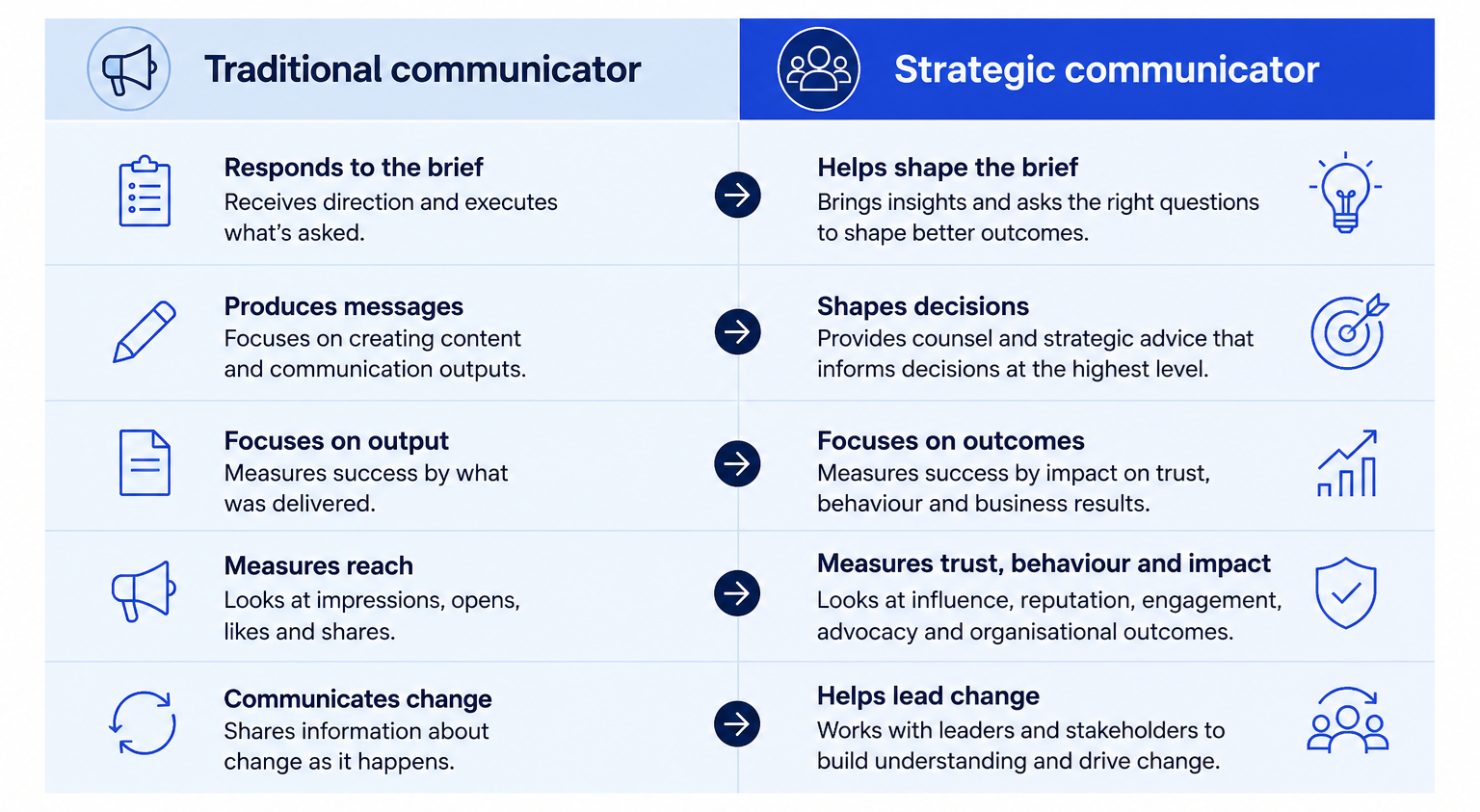
The distinction is sharper than it might first appear:
- The practitioner asks: How do we announce this change?
- The strategic communicator asks: How do we lead people through this change, protect trust and emerge stronger?
That second question requires a seat at the table long before the announcement is written. It requires judgement, foresight and the confidence to challenge a decision, not just communicate it.
The most valuable communicators today aren't the ones who write the message. They're the ones who help shape what the message should be.
This is why Australian organisations are increasingly hiring for communication strategy rather than communication tactics. The tactical work still matters. But it's no longer where the value lives.
According to Jobs and Skills Australia, employment for Public Relations Professionals is projected to grow by 13.3% over the next five years, significantly outpacing average occupational growth. That growth reflects a profession in transition, one being asked to operate at a fundamentally different level.

The shift can be seen in how the role has changed day to day:
Why trust became the most valuable currency
Reputation used to be something you managed quarterly. Now it moves at the speed of a single post.
The 2025 Edelman Trust Barometer makes the stakes plain. Australia has slipped into distrust territory, with 62% of Australians holding a moderate or high sense of grievance toward government, business and the wealthy. People increasingly expect businesses to lead on the issues that matter most to them. Employees, customers and communities are no longer passive audiences. They're active participants who reward authenticity and punish silence.
That expectation lands squarely on the communicator's desk.
Reputation management has become a discipline of anticipation, not damage control. It means understanding stakeholder sentiment before it hardens into crisis. It means advising leaders on when to speak, when to act and when to listen. And it means recognising that what an organisation does speaks louder than what it says.
Consider how Australian institutions have navigated intense public scrutiny in recent years. Banks rebuilt credibility after the Royal Commission. Government agencies managed public confidence through the pandemic and a succession of natural disasters. In each case, the organisations that recovered fastest treated communication not as spin, but as a genuine leadership function: honest, fast and human.
Edelman's research reinforces a clear pathway forward: organisations that prioritise transparency and community engagement rebuild trust faster. This isn't a soft ideal. It's a competitive differentiator.
Trust, it turns out, is built in the decisions, not just the messaging.
The misinformation challenge changes everything
Trust is under pressure from a new direction too: the rapid spread of misinformation.
A 2025 global study from the University of Melbourne and KPMG found that 70% of people globally are unsure whether online content can be trusted because they can't tell what is real or AI-generated. In Australia, two in five people have personally experienced or observed the negative impacts of AI-generated misinformation. Eighty-seven percent of respondents said they want stronger laws and action to combat it.
This creates a defining challenge for communicators. In an environment where content is cheap, abundant and increasingly unverifiable, the premium shifts to credibility. Organisations that communicate with consistency, transparency and genuine accountability stand out not just as good corporate citizens, but as ones worth listening to.
Strategic communicators are now custodians of that credibility. Their role isn't simply to produce content. It's to ensure that every piece of communication earns and maintains the audience's trust.

AI is taking the tasks. Strategic communicators keep the judgement.
Here's the uncomfortable truth many communicators are sitting with: a lot of traditional communication work can now be done by a machine.
Drafting content. Summarising reports. Generating first-draft copy. Scheduling, tagging and reporting. AI tools handle these tasks quickly and cheaply, and they're only getting better.
But this isn't the threat it first appears to be. It's a clarifying force.
The University of Melbourne and KPMG study found that three in five Australian employees now regularly use AI at work, with workplace adoption among the fastest growing in the world since 2022. Yet the same research reveals a growing gap: AI literacy is lagging, governance is underdone and organisations are struggling to use AI responsibly, not just quickly.
This gap creates an opportunity for communicators who can think beyond the tool.
The World Economic Forum's Future of Jobs research consistently points to analytical thinking, leadership, resilience and influence as the skills that will matter most in the decade ahead. These are precisely the capabilities AI can't replicate. Machines can produce a press release. They can't read a room, navigate a board's politics or earn a sceptical stakeholder's trust over a difficult conversation.
As AI absorbs the tactical, strategic communication becomes the differentiator. The future belongs to strategic communicators: professionals who can interpret context, advise leaders, build trust and shape behaviour, not simply produce content.
The communicators who thrive will be the ones who let AI take the routine, then redirect their energy toward what only humans can do:
- Exercising judgement under pressure
- Building genuine stakeholder relationships
- Advising leaders on complex, high-stakes decisions
- Shaping culture and behaviour, not just awareness
LinkedIn's Workforce Report tells the same story. Communication, leadership, strategic thinking and relationship management continue to top the list of in-demand skills. The market is rewarding the human edge.
Communicating through change and uncertainty
Restructures. Mergers. Crises. Cultural transformation. Australian organisations are in a near-constant state of change, and change is where communication either makes or breaks an outcome.
Poorly handled change breeds rumour, resistance and disengagement. Well-handled change builds momentum and trust. The variable is rarely the strategy itself. It's how that strategy is communicated, sequenced and felt by the people living through it.
Research supports this consistently. A study published in the Journal of Change Management found that communication quality is one of the strongest predictors of employee commitment during organisational change, more influential than the nature of the change itself. People don't resist change. They resist being changed without being heard.
This is where the strategic communicator earns their place. They don't just announce change. They:
- Translate complexity into clarity
- Anticipate how different stakeholders will react
- Equip leaders to communicate with empathy and consistency
- Keep listening as the change unfolds, adjusting in real time
Change communication has become one of the most sought-after capabilities in corporate communication and corporate affairs precisely because the cost of getting it wrong is so high. In high-scrutiny sectors including financial services, government and healthcare, the ability to communicate through complexity is fast becoming a non-negotiable leadership attribute.

Ready to move from execution to influence? Explore the UTS Online Master of Strategic Communication and build the capability to advise, lead and shape organisational decisions.
The communicator as trusted advisor
The biggest shift of all is one of identity. The senior communicator is no longer a service provider waiting for a brief. They're an advisor whose counsel shapes the brief itself.
This is reflected in how Australian organisations are structuring their leadership teams. Corporate affairs, reputation and stakeholder engagement functions are increasingly represented at executive level. Boards and chief executives need someone who understands not just how to communicate, but how communication intersects with strategy, risk, culture and reputation.
The 2025 Edelman Trust Barometer found that among Australians with a high sense of grievance, business is seen as significantly less ethical and less competent. The implication for organisations is clear: it's not enough to have a good story. You need someone in the room who understands how trust is built and lost, and who can advise accordingly.
Becoming that advisor requires a different set of capabilities:
- Strategic thinking. Connecting communication to business objectives and long-term value.
- Influence. Earning the right to challenge decisions and be heard at the highest level.
- Stakeholder engagement. Building relationships across an organisation and beyond it.
- Commercial acumen. Understanding the business well enough to advise it credibly.
- Composure. Leading calmly when reputation and trust are on the line.
These aren’t skills absorbed by accident. They’re built deliberately through experience, reflection and formal study designed to bridge the gap between practitioner and leader.
The leap from communicator to communication leader isn’t about doing more. It’s about thinking differently.

Building the capabilities that count
For communication professionals in Australia, the question worth sitting with is an honest one: Am I building the capabilities the future is asking for?
If your work still lives mostly in execution, there’s a clear path forward. The skills that define the strategic communicator, including strategic thinking, leadership, stakeholder engagement and reputation management, can be developed intentionally.
Postgraduate study has emerged as one of the most direct routes for experienced practitioners to make that transition. Courses designed specifically for communication professionals can bridge the gap between hands-on experience and the strategic leadership capability that senior roles now demand. They do so not by replacing what practitioners already know, but by building the frameworks, confidence and vocabulary that let them operate credibly at the highest level.
For senior communicators ready to make the leap from execution to influence, UTS Online’s Master of Strategic Communication provides the framework to lead with confidence. You’ll learn not just how to manage a crisis, but how to advise leaders through one. Not just how to tell an organisation’s story, but how to shape the narrative that guides strategy, culture and trust.
Delivered entirely online and designed for working professionals, the course builds capability across stakeholder engagement, crisis and reputation management, organisational storytelling, intercultural communication and strategic campaign development. It is designed to help communication professionals move from delivering messages to shaping decisions.
UTS is ranked in the top 100 universities globally (QS World University Rankings, 2026) and fifth in Australia for communication and media studies (QS World University Rankings by Subject, 2024), giving your qualification the credibility to match your ambition.
For those who prefer a more gradual entry point, the Graduate Certificate in Strategic Communication and the Graduate Certificate in Corporate Communication offer focused, eight-month pathways that can stand alone or lead into the full master’s degree. Both are built around the same principle: communication at the senior level is a leadership discipline, and the skills to practise it well can be taught.
Whether you’re ready to commit to the master’s or want to start with a graduate certificate first, UTS Online’s communication pathways are designed to meet you where you are and support where you want to go next.
The future is being written now
Communication has spent decades fighting to be taken seriously as a strategic function. That fight is largely won. The profession now sits at the centre of organisational strategy, reputation and trust, exactly where the hardest and most important questions are being asked.
The context has never been more complex. Australians are navigating declining institutional trust, accelerating AI adoption and a media environment in which misinformation is endemic. In that environment, organisations need communicators who can do more than manage messages. They need people who can shape decisions, build credibility and lead through uncertainty.
That's not a job for a messenger. It's a job for a leader.
The communicators who recognise this moment, and deliberately build for it, won't just keep pace with change. They'll lead it.
The message is no longer the end of the process. It's the beginning of influence.
So here's the question worth sitting with: as AI takes the tasks and trust becomes everything, what kind of communicator will you choose to become?

Frequently asked questions
A strategic communicator is a communication professional who helps shape organisational decisions, build trust, manage reputation and guide leaders through change, rather than simply producing messages or campaigns.
Because organisations need communicators who can advise on trust, stakeholder expectations, misinformation, AI, culture and change, all of which affect business strategy and reputation.
AI is automating routine communication tasks such as drafting, summarising and scheduling, making human capabilities such as judgement, influence, stakeholder trust and strategic advice more valuable.
Strategic communicators need strategic thinking, stakeholder engagement, influence, commercial acumen, reputation management, change communication and leadership capability.