Why AI won’t replace educators, but will reshape education leadership

Ask anyone what AI means for education, and you’ll hear the same anxious question: will the machines take our jobs?
It’s the wrong question.
Here’s the better one: as AI reshapes how we learn, who will lead the change?
That’s where the real story lives. AI is already transforming schools, universities, corporate training rooms and workplace learning programs across Australia. It drafts content, marks assessments, personalises learning paths and crunches data at a scale no human could match. Yet the most valuable parts of education, the parts that actually change people, remain stubbornly, beautifully human.
The future doesn't belong to educators who fear AI. It belongs to those who lead with it.
What AI can already take off an educator’s plate
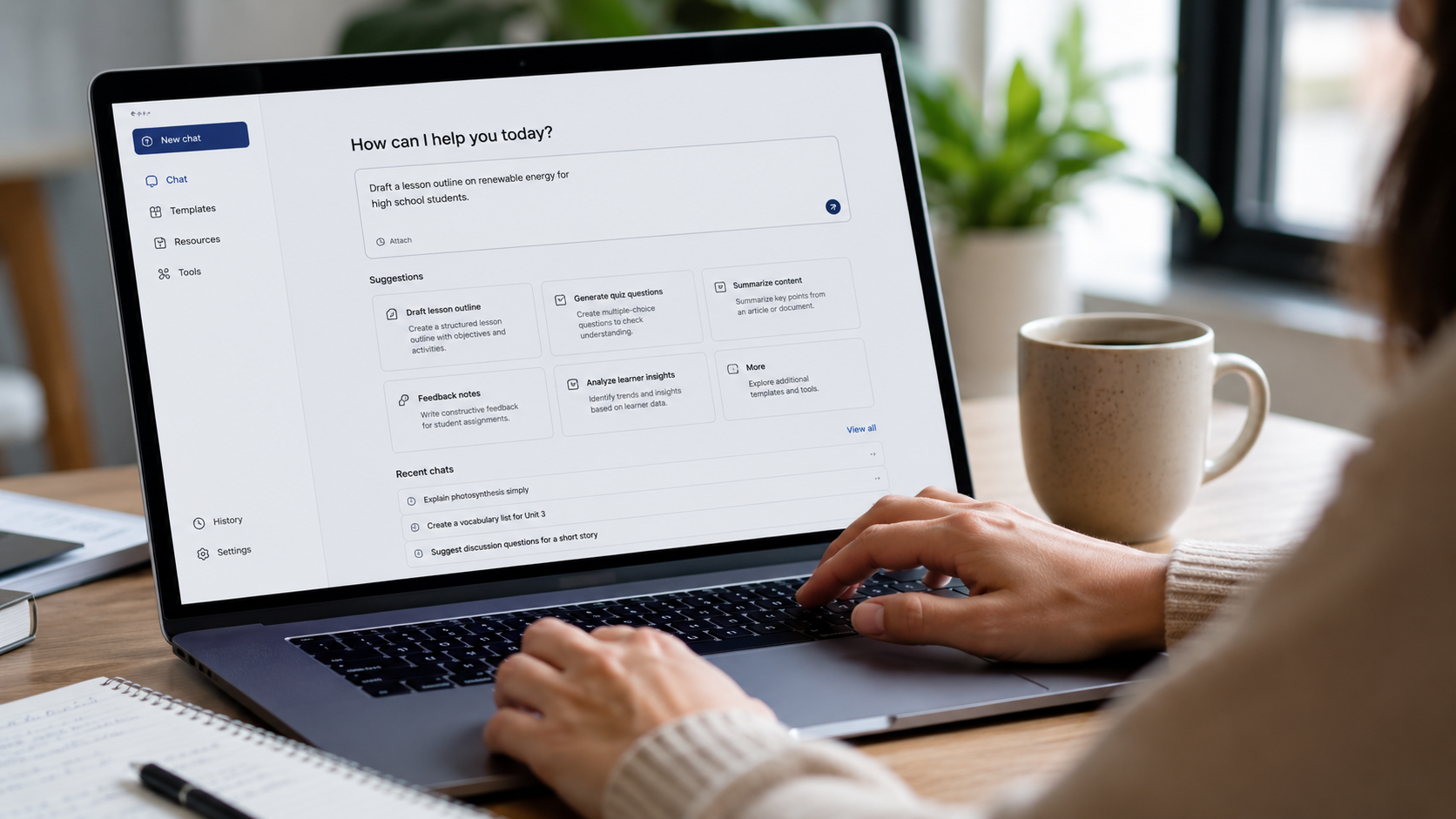
Let's be honest about the technology. AI is genuinely good at a growing list of tasks that once consumed hours of an educator's week:
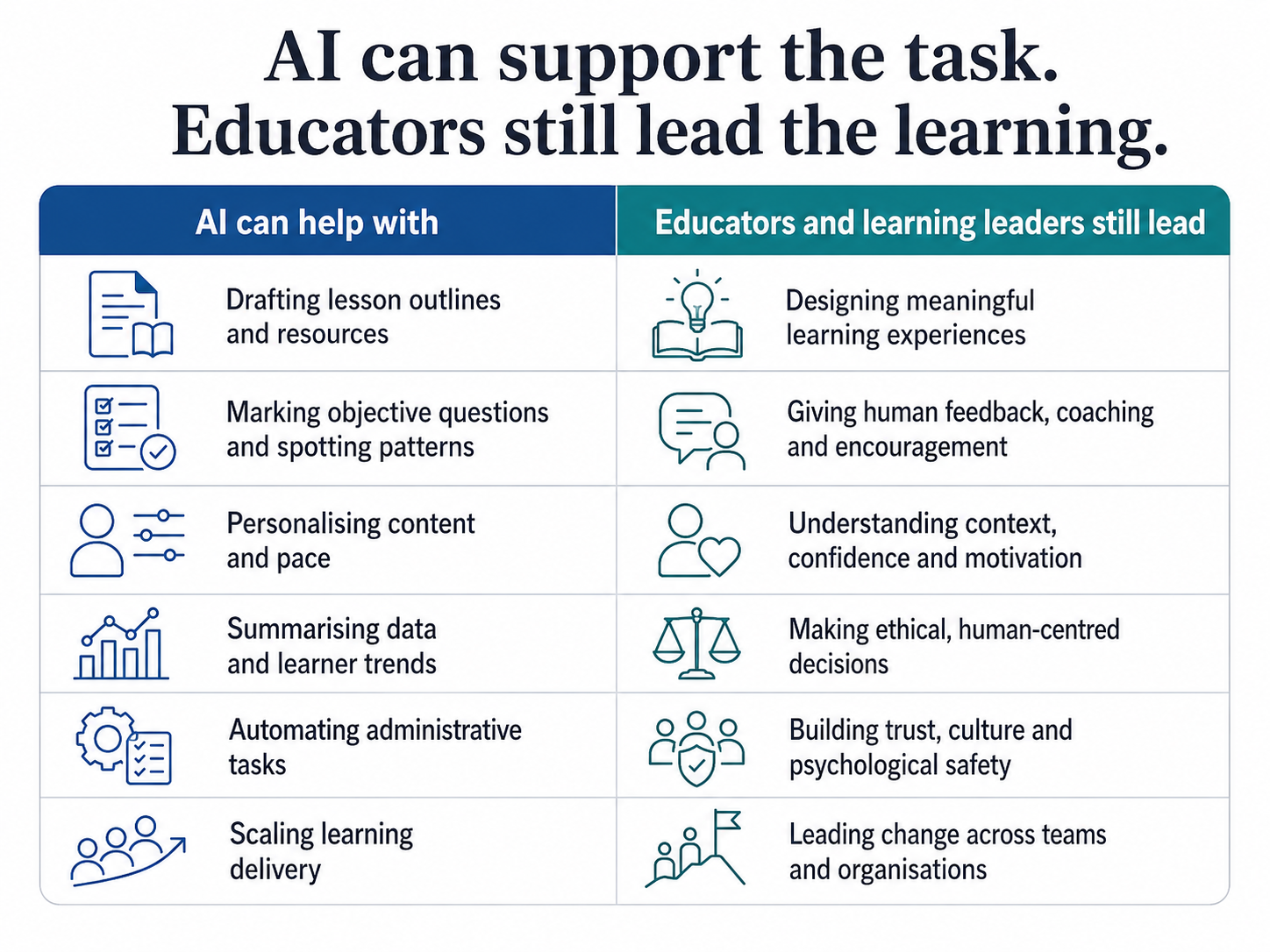
- Content generation. Drafting lesson outlines, quizzes, summaries and learning materials in seconds.
- Administrative support. Scheduling, reporting, formatting and the endless paperwork that pulls educators away from people.
- Assessment support. Marking objective questions, flagging patterns in student work and speeding up feedback loops.
- Personalisation. Adapting content to individual learners, adjusting pace and pitching difficulty to the person in front of the screen.
- Data analysis. Spotting trends across cohorts, predicting who might disengage and surfacing insights buried in spreadsheets.
This isn't science fiction. It's happening right now, across Australian classrooms and corporate learning teams alike. And it's a gift, because every hour AI gives back is an hour an educator can spend doing what only they can do.
The mistake is assuming the technology is the destination. It isn't. It's the runway.
The human work AI can’t replace
Strip away the admin and the marking, and what's left? The heart of education.
AI can generate a lesson, but it can't read the room. It can personalise a learning path, but it can't notice the student who's quietly struggling and stay back to have a real conversation. It can summarise a meeting, but it can't build the trust that makes a team take a risk on a new idea. It can produce feedback in seconds, but it can't mentor someone through a crisis of confidence or help a team make sense of an organisational shift that threatens everything they know.
The capabilities that define great educators and learning leaders are exactly the ones machines can't replicate:
- Leadership. Setting a vision and bringing people with you, even through uncertainty.
- Communication. Translating complexity into meaning for the person who needs it most.
- Mentoring and coaching. Drawing out potential others can't see in themselves.
- Relationship building. The connection that turns information into transformation.
- Emotional intelligence. Reading nuance, responding with empathy and holding space for people who are learning.
- Ethical decision-making. Judging not just what's possible, but what's right.
- Change leadership. Guiding people through disruption without losing them along the way.
These aren't soft skills. They're the hardest skills of all, and in an AI-enabled world, they're becoming the most valuable currency in education and organisational learning.

How AI is reshaping every learning setting across Australia
The shift isn't confined to one corner of education. It's rippling across every place people learn, from school halls to boardrooms.
In schools, educators are moving the conversation from panic to principle. In 2023, the Australian Department of Education released the Australian Framework for Generative AI in Schools, built on six principles spanning teaching and learning, human agency and wellbeing. Education Ministers endorsed a 2024 review of the framework, signalling that responsible AI integration in Australian schools is a national priority, not a passing trend. The framework doesn't replace the teacher. It frees them to teach. But it also demands a new kind of educational leadership: one that can navigate ethics, policy and practice in equal measure.
In higher education, the Tertiary Education Quality and Standards Agency (TEQSA) has published guidance on assessment reform in the age of AI, helping institutions redesign learning for an era where generating an essay takes seconds. The focus is shifting from policing AI use to rebuilding assessment around what humans uniquely do: critical thinking, contextual judgement and original reasoning. Educators who can lead that redesign are already in demand.
In corporate learning and development, AI is accelerating how organisations build capability. According to LinkedIn's Workplace Learning Report, AI skills and career development are now the top priorities for L&D teams globally, a trend mirrored strongly across Australian and New Zealand organisations. AI personalises training, surfaces skills gaps and delivers learning in the flow of work. But someone still has to design that strategy, secure stakeholder buy-in and lead the cultural change that makes learning stick across the organisation.
In workplace and organisational learning, AI handles the data and increasingly the delivery. The strategy stays human. Who decides what the organisation needs to learn next? Who reads the people dynamics and leads the capability shift? Who holds the tension between what the algorithm recommends and what the culture can absorb? That's not a job for a tool. That's a job for a learning leader.
Across all of it, the pattern holds. AI changes the how. People still own the why.

From knowledge holder to learning leader
For decades, the educator was the keeper of knowledge. You showed up, they shared what they knew, you took notes and moved on.
AI has dismantled that model entirely. When information is instant and infinite, knowing the most is no longer the point. The value has moved, and it's moved fast.
Today's educator is becoming a facilitator, a learning designer, a coach and a strategic leader. They curate rather than dictate. They guide learners through an abundance of information rather than rationing access to it. They design experiences that build judgement, adaptability and critical thinking, not just recall of facts.
Consider what this looks like in practice. A learning and development manager at a large health organisation in Australia is no longer simply running compliance training. They're redesigning how their teams learn, identifying where AI tools can accelerate development and where human mentorship is non-negotiable. They're advising the executive team on capability strategy, leading change across a workforce grappling with new technologies and building the psychological safety that allows people to experiment and grow.
That's a fundamentally different role. And it requires a fundamentally different skill set.
This is a promotion, not a demotion. It asks more of educators and learning professionals, not less. It rewards the ability to design meaningful learning, lead people through ambiguity and steer whole organisations toward capability and growth.
The educators who thrive in this era won't be the ones who memorised the most. They'll be the ones who can lead the most.
Ready to lead learning in an AI-enabled world? Explore UTS Online’s education courses and build the capability to design learning, lead change and support people through transformation.
AI literacy: the new professional baseline
There's another shift happening quietly alongside all of this, and it's worth naming directly.
AI literacy is becoming a baseline expectation for education and learning professionals, not an optional extra. You don't need to be a data scientist. But you do need to understand what AI tools can and can't do, how to use them responsibly and how to lead teams and organisations in doing the same.
This includes understanding the ethical dimensions of AI, including questions of bias, data privacy, transparency and equity. It includes being able to critically evaluate AI-generated content rather than accepting it uncritically. And it includes having the confidence to make human judgements about where AI should lead the work and where it absolutely shouldn't.
For learning professionals, this fluency isn't just useful. It's what makes you credible as a guide for others navigating the same terrain.
The Australian Framework for Generative AI in Schools recognises this explicitly, emphasising human agency and educator capability as core pillars. TEQSA's assessment reform guidance echoes it in the higher education context. The message from Australian education authorities is consistent: AI is a tool, and effective humans need to know how to wield it with purpose and wisdom.
How to lead AI without losing the human
The question many learning leaders are wrestling with right now isn't whether to use AI. That debate is largely over. The question is how to integrate it responsibly while maintaining quality, trust and the human connection that makes learning transformative.
That's a leadership question. And it doesn't have a simple technical answer.
It requires professionals who can evaluate AI tools critically against learning outcomes. Who can set policy and practice guidelines that protect learners and staff. Who can build the culture of trust in which people are willing to experiment, fail and grow. Who can keep the wellbeing and dignity of every learner at the centre of a system that is becoming faster, more data-driven and more automated by the year.
In practice, this looks like a training manager who introduces AI-generated learning content but builds in human debrief sessions where teams apply and interrogate that content together. It looks like a school leader who develops a whole-school AI policy that balances innovation with integrity, consulting staff and families throughout. It looks like an organisational learning specialist who uses data insights to identify a skills gap but then designs a coaching program, not just an e-learning module, to close it.
These leaders aren't just managing AI. They're shaping how their organisations relate to it. That's a different kind of authority, and it's becoming one of the most important roles in any institution.

Why learning leaders are becoming more valuable
This isn't a niche conversation for a handful of specialists. The demand for skilled education and learning professionals across Australia is strong and growing. Data from the QILT Graduate Outcomes Survey shows that 91% of postgraduate education graduates are employed full-time within four months of graduating, a figure that reflects just how in-demand these capabilities are across sectors.
The Australian Labour Market Information Portal has projected continued growth in education and learning and development roles, and AI is accelerating that demand rather than replacing it. Every organisation racing to adopt AI faces the same bottleneck: people. New tools demand new skills. New skills demand someone to design the learning, lead the rollout and manage the human side of change.
That someone is a learning leader.
The professionals who combine technological fluency with leadership, critical thinking, deep human connection and strategic decision-making won't just survive the AI era. They'll define it.
Building the capabilities that matter most
So where does that leave you?
If AI is going to handle the routine, the future favours those who can do everything it can't. That means deliberately building the capabilities that make you not just relevant, but irreplaceable:
- Learning design and facilitation, so you can create experiences that actually change how people think and perform.
- Leadership and change management, so you can carry people through transformation without leaving anyone behind.
- Organisational learning strategy, so you can design how whole teams and institutions grow, adapt and innovate.
- Ethical reasoning and AI literacy, so you can make sound judgements about where technology should serve and where human judgement must lead.
These are learnable. They're the deep capabilities of the learning leader: designing innovative learning experiences, mentoring others, evaluating what works and driving strategic change across schools, workplaces and organisations.
The good news is that these capabilities can be intentionally developed. With the right postgraduate study, professionals can build the strategic expertise, leadership capability and practical experience needed to thrive alongside AI rather than compete with it.
If you’re ready to shift from managing training to leading learning strategy, UTS Online’s Master of Education (Learning and Leadership) is designed to support that next step. The course doesn't just explore learning theory; it builds the leadership, change management and strategic design capabilities needed to guide people, teams and organisations through change, including change shaped by AI.
For professionals wanting to build focused expertise sooner, the Graduate Certificate in Education (Learning and Leadership) introduces cutting-edge approaches to learning design and leadership, while the Graduate Certificate in Organisational and Workplace Learning is built for those leading professional development and capability building in complex organisational environments. All three programs are delivered 100% online, designed for working professionals and structured so you can apply what you learn directly to your current role, from day one.
UTS is ranked #2 in Australia for education and among the nation's leading universities for graduate employability, providing a strong foundation for professionals building careers at the intersection of learning, leadership and organisational change.
The future of educational leadership
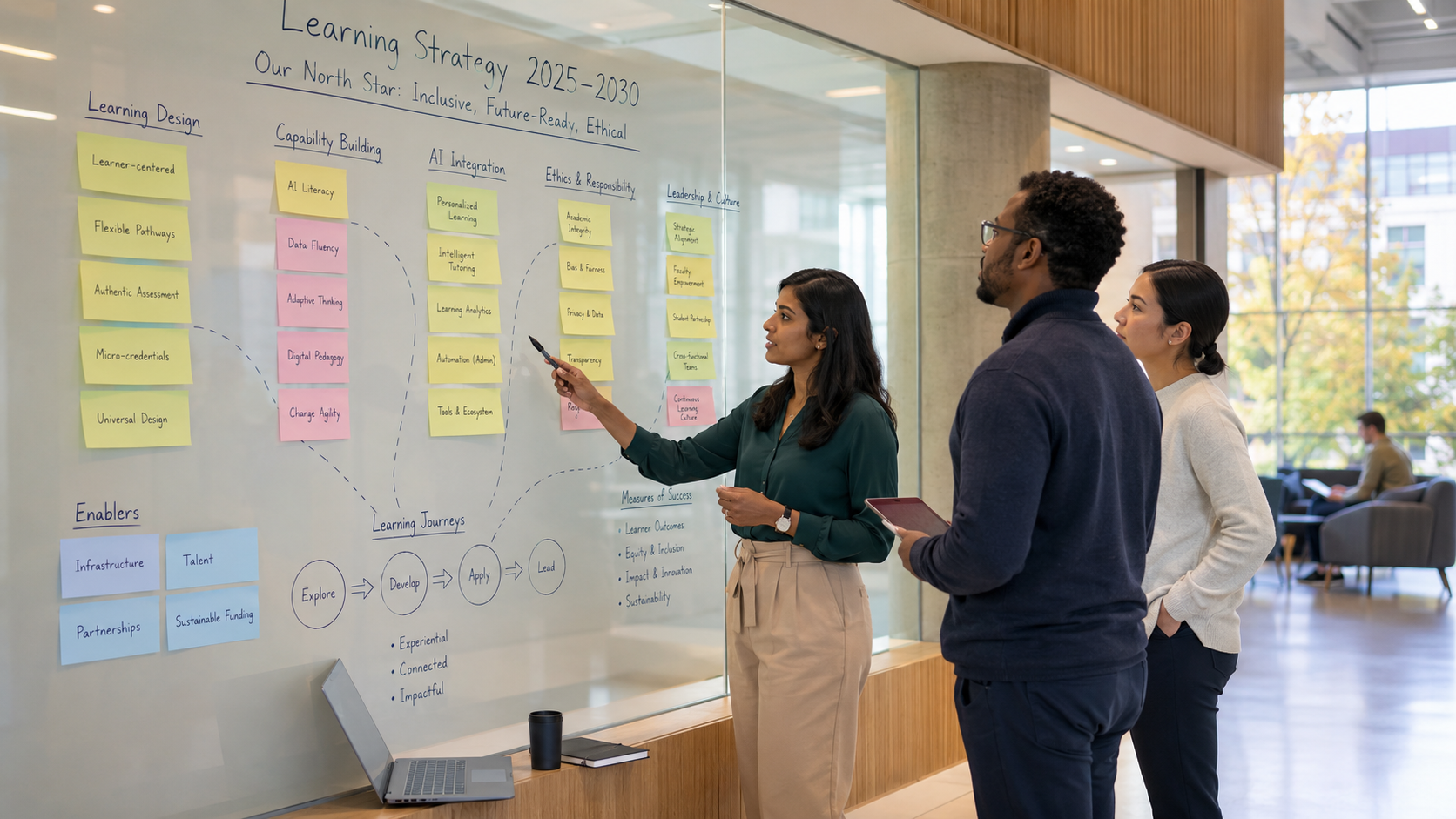
The leaders who will shape education in the next decade aren't the ones waiting for AI to stabilise before they act. They're the ones building their capability now, so they can lead others through the change with confidence and clarity.
Educational leadership has always required courage: the courage to put learning first, to challenge what isn't working and to imagine something better. What's new is the scale of the challenge and the speed of the change.
AI is not arriving in education as a distant future scenario. It's here, it's accelerating and it's already changing what every educator, trainer, L&D professional and organisational learning specialist is expected to know and do.
But the fundamentals of great learning haven't changed. People still need to feel seen, challenged and supported. They still need leaders who can read a room, hold a vision and build the trust that makes growth possible. They still need someone who can look at a complex situation and make a wise, human, ethical call.
That's you. That's the work.
AI won’t take your seat at the table. But it will change what’s expected of everyone sitting there.
The question isn’t whether you’ll work alongside AI. You already do.
The question is: will you be the leader who defines how it’s done?
Ready to lead learning in an AI-enabled world?
UTS Online’s education courses are designed for educators, trainers and learning professionals who want to build capability in learning design, leadership, organisational learning and applied research.
Explore the Master of Education (Learning and Leadership), Graduate Certificate in Education (Learning and Leadership) or Graduate Certificate in Organisational and Workplace Learning to find the pathway that fits your goals.
Frequently asked questions
AI is unlikely to replace educators entirely, but it is changing what educators are expected to do. Routine tasks such as content drafting, basic marking and administration may become more automated, while human capabilities such as mentoring, judgement, empathy, leadership and ethical decision-making become more important.
AI is shifting education leadership from managing content delivery to leading responsible technology integration, assessment redesign, staff capability building and learner support. Leaders need to understand both what AI can do and where human judgement must remain central.
Educators increasingly need AI literacy, learning design capability, ethical reasoning, communication, coaching, change leadership and the ability to use data responsibly.
L&D teams can use AI to personalise learning, identify skills gaps and streamline content development, but they still need human leaders to set strategy, protect trust, evaluate quality and guide behaviour change.
Education and workplace learning are changing quickly. Postgraduate study can help educators, trainers and learning professionals build the leadership, design and strategic capability needed to guide people and organisations through AI-enabled change.