You know healthcare. But can you lead it? Six health services management skills that matter next
The job changes before the title does
One day, the problem gets bigger than your job description.
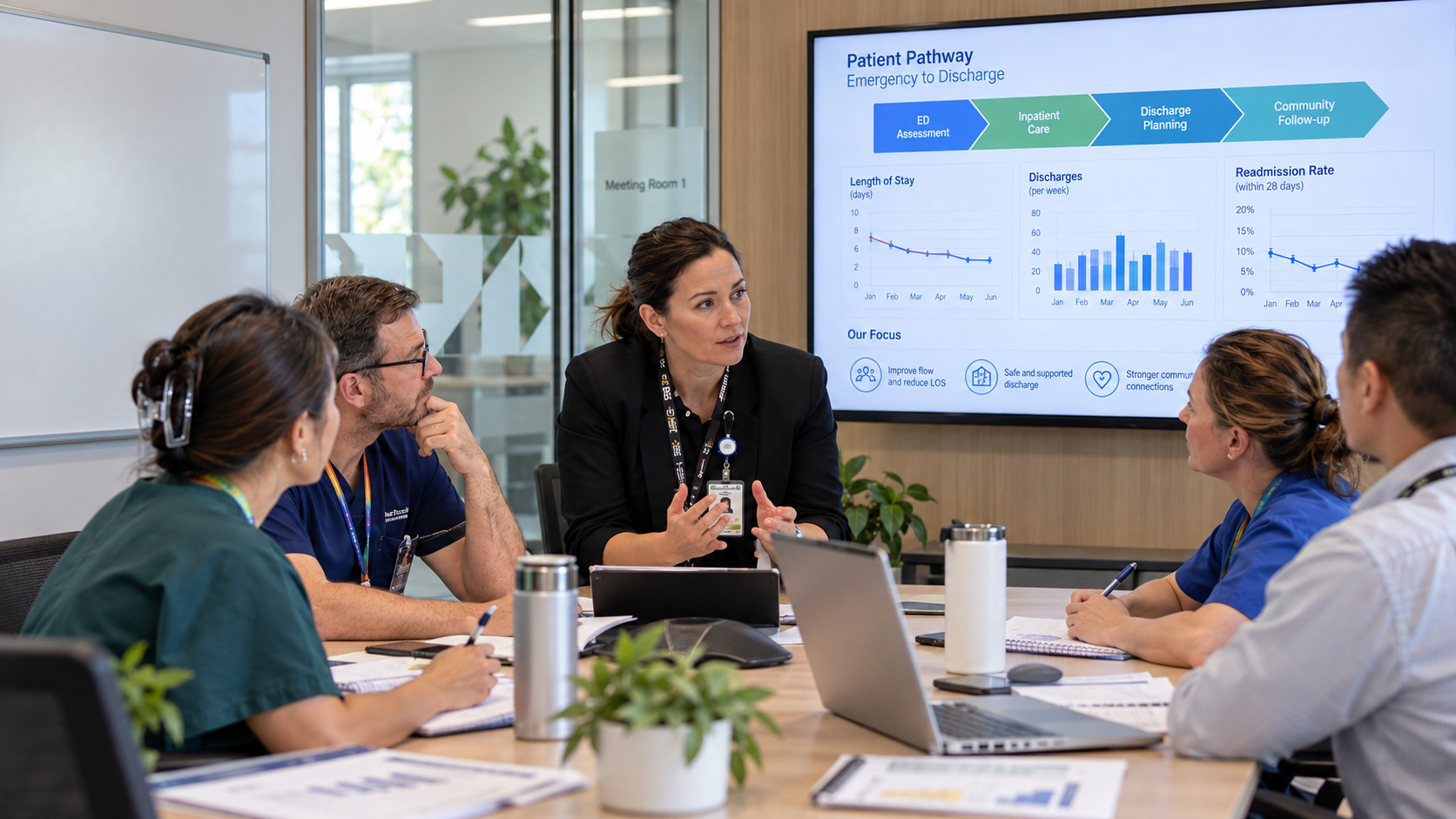
Waiting times are climbing. Staff are stretched. A new model of care is on the table. The dashboard is full of numbers. Everyone agrees something needs to change, but not what should change.
This is where being experienced in healthcare and being ready to manage it start to become two different things.
Because the further you move in health and social care, the less likely the problem is to belong neatly to one patient, one profession, one team or even one organisation.
Clinical and professional expertise helps you understand the consequences. Management capability helps you work out what is driving the problem and what can realistically be done about it.
That means learning to see beyond one patient, profession or team. You need to understand how funding, policy and service pathways shape what is possible; decide which data matters; recognise the organisational conditions affecting performance; bring people together around change; and judge whether a good idea is feasible and sustainable.
These are health services management skills. You may already be using some of them without calling yourself a manager.
As your responsibilities grow, the question gradually shifts from:
How do I do my part well?
to:
How do all these parts work together?
Health Care and Social Assistance is Australia’s largest employing industry, accounting for 16.3% of the workforce. Managing within a sector of this scale and complexity requires more than professional expertise alone.
16.3% of Australia’s workforce works in Health Care and Social Assistance
Jobs and Skills Australia, Occupation and Industry Profiles
Across the six core subjects in the UTS Online Master of Health Services Management, you’ll build capability in health systems, data-informed decision-making, organisational management, quality and safety, leadership and value-based care.
Here is what those capabilities look like when the problem is yours to solve.
Systems thinking: when the problem is bigger than your team
Core subject: Foundations of Healthcare Systems
You can fix what is happening within your team and still not fix the problem.
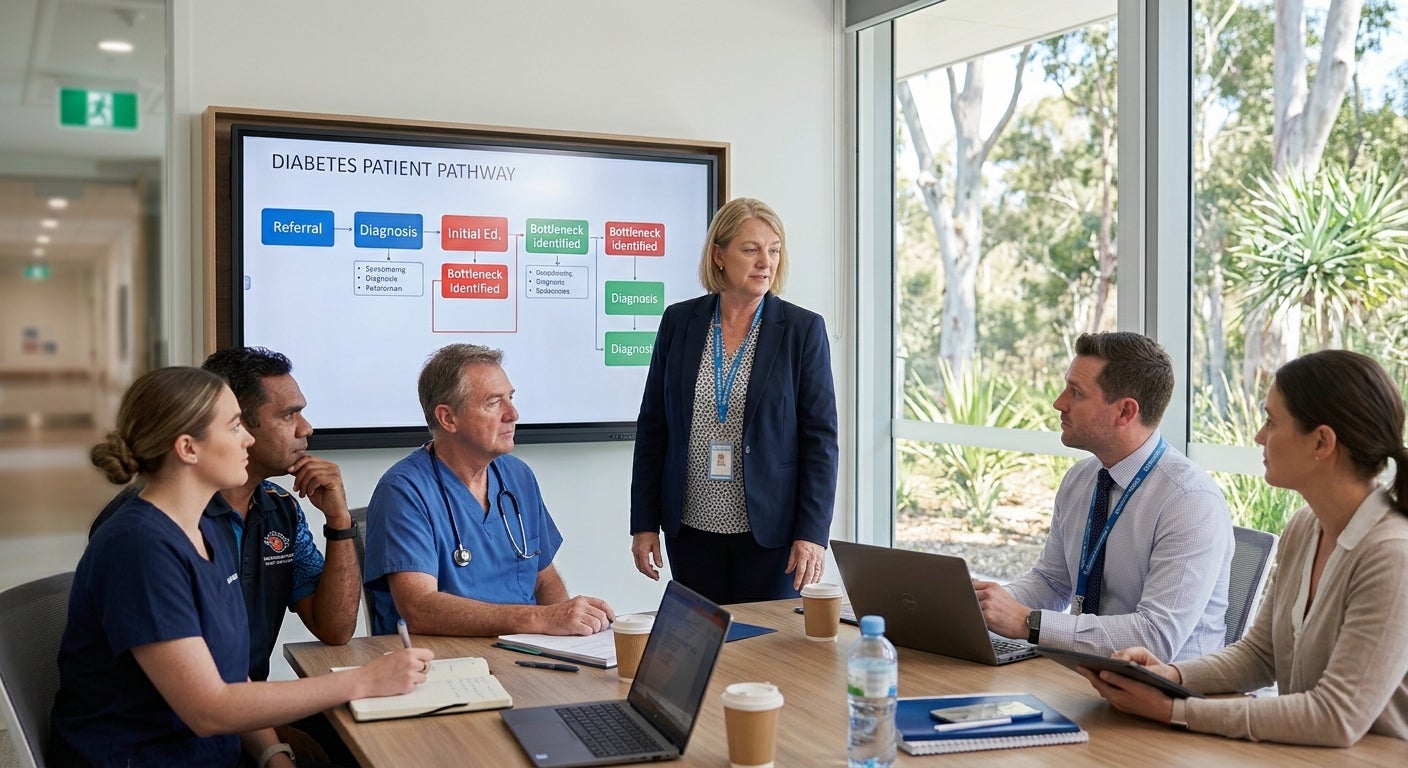
A patient pathway may cross hospitals, primary and social care. Access may depend on decisions about funding, policy, governance and the division of responsibility between organisations. The visible problem might be a delayed referral, while the underlying cause sits several steps earlier.
Through Foundations of Healthcare Systems, you’ll develop a broader understanding of how health and social care systems operate and how their different parts interact. You’ll learn to examine patient and service pathways, identify where responsibility and funding sit, and consider how a decision in one part of the system can create consequences elsewhere.
Instead of asking only what is happening within a service, you’ll learn to ask: Where is the patient getting stuck? Which organisations and funding arrangements shape the pathway? Is the problem really occurring where it first becomes visible?
Where this capability can take you: Health Services Manager, Health Services Administrator, Health Program Officer, Policy Officer and Project Officer.
Seeing the system gives you a wider view of the problem.
The next challenge is working out what the evidence is actually telling you.
Healthcare data: when the dashboard gives you numbers, not answers
Core subject: Using Health Care Data for Decision Making
A waiting-time indicator tells you there is a problem. It does not tell you why.
Has demand increased? Has staffing changed? Is one part of the pathway creating a bottleneck? Is this a short-term variation or an emerging trend? Are you looking at the right measure?
Through Using Health Care Data for Decision Making, you’ll develop the ability to interpret health service, activity and performance data, identify meaningful trends and variation, select useful indicators and assess the quality of the information in front of you.
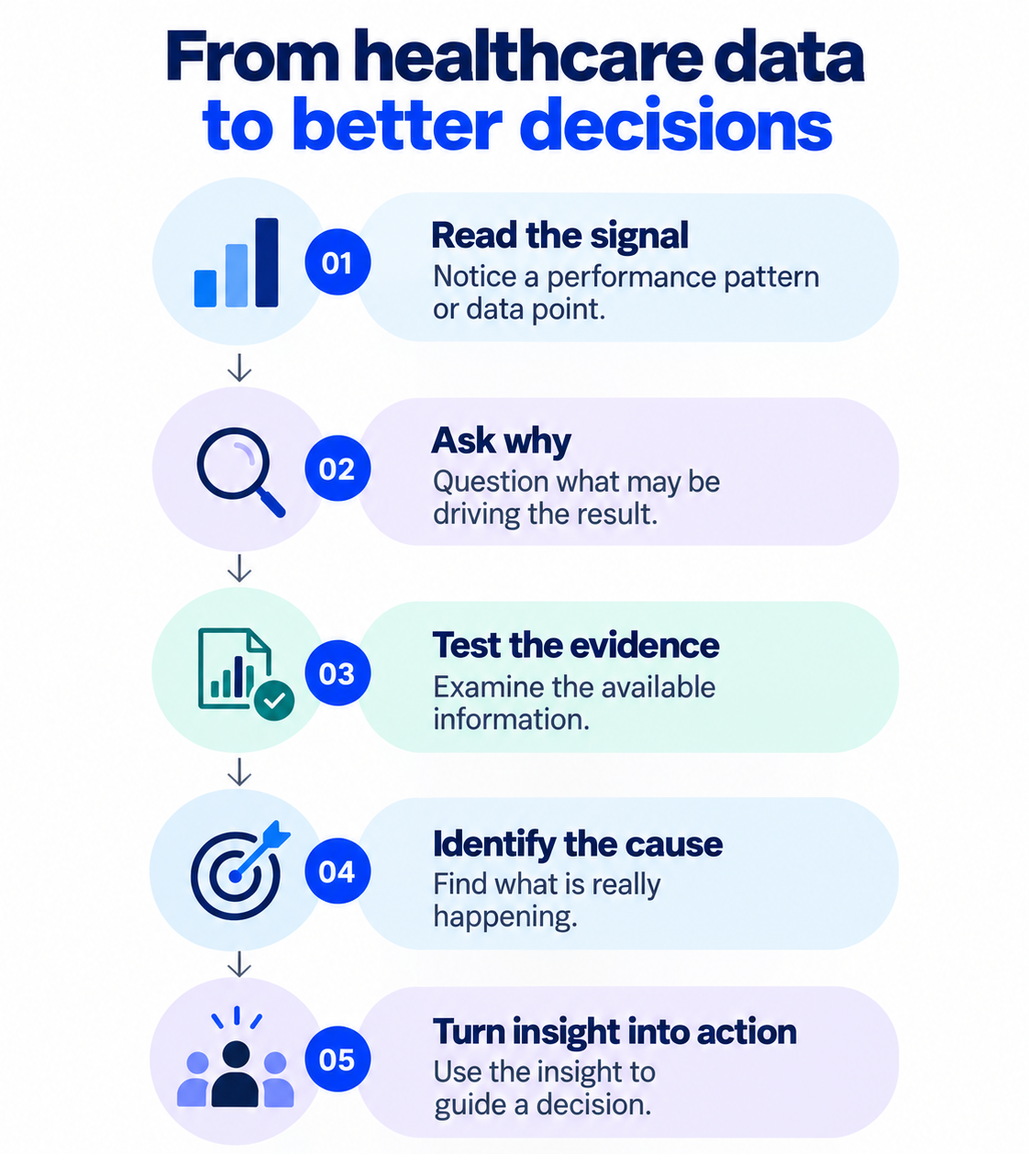
Most importantly, you’ll learn to turn information into action. That means using data to ask better questions, test assumptions, locate potential causes and communicate findings to the people deciding what happens next.
You are no longer simply receiving the report. You are asking whether it tells the right story.
Where this capability can take you: Health Data Analyst, Business Analyst, Project Officer and Health Services Manager.
Because healthcare rarely needs another dashboard.
It needs people who know what to ask of it.
Organisational management: when the strategy is right but nothing changes
Core subject: Organisational Management in Health Care
Sometimes everybody agrees on the destination. Getting there is the problem.
A strategy may be supported by good evidence and senior leadership, but implementation must contend with workforce pressures, established ways of working, competing priorities, limited resources and change fatigue.
Through Organisational Management in Health Care, you’ll develop capability in organisational strategy, culture, workforce and human resource management, team performance and stakeholder interests.
You’ll learn to look beneath the surface of organisational problems. Is the strategy unclear, or is the culture working against it? Is performance being shaped by skills, structure or workload? Are teams being asked to deliver competing priorities? Do stakeholders agree on what success looks like?
As your responsibility grows, your work becomes less about completing one task and more about creating the conditions that allow people, teams and services to perform well.
Where this capability can take you: Health Services Manager, Operations Manager, Clinical Manager, Program Manager and Practice Manager.
And when the problem affects the quality or safety of care, understanding those conditions becomes even more important.
Quality and safety: when ‘human error’ isn’t a good enough answer
Core subject: Improving Safety and Quality in Healthcare
When something goes wrong, the immediate question is: What happened?
The more useful question may be: What made it possible?
An incident may appear to come down to one action or decision. Look more closely and you may find problems involving processes, communication, staffing, equipment, workload or service design.
Through Improving Safety and Quality in Healthcare, you’ll develop capability in clinical governance, accreditation, incident and complaint analysis, clinical risk and systems analysis. You’ll explore approaches including root cause analysis, human factors and open disclosure, and consider how organisations build stronger safety cultures and more resilient services.
This changes how you respond to problems. Could the same conditions cause another incident tomorrow? Are complaints revealing a wider pattern? Where does risk sit before something goes wrong?
Quality and safety expertise is not only relevant to roles with “Quality” in the title. Anyone managing a health service needs to understand how risk, governance and improvement connect with everyday care.
Where this capability can take you: Quality and Safety Manager, Clinical Governance Manager, Quality Improvement Manager, Risk Manager and Clinical Services Manager.
You can redesign the system on paper.
Whether people move with it is another matter.
Healthcare leadership: when everyone wants change, but not the same change
Core subject: Leading Health and Social Care
Leadership looks straightforward when everyone agrees. Healthcare rarely gives you that luxury.
Senior leaders may want progress while different clinical groups disagree about the proposed change. Staff may already be stretched, and administrators may see operational problems that others have missed. Everyone brings legitimate expertise, but someone still needs to move the conversation forward.
Leadership in health and social care is not simply about authority. It often means influencing people who do not report to you, navigating professional boundaries, holding difficult conversations and helping people understand not only what is changing, but why.
Through Leading Health and Social Care, you’ll strengthen your ability to lead multidisciplinary teams, adapt your approach to different situations, communicate across professional groups, navigate conflict and lead through change. You’ll also critically examine your own leadership practice.
Clinical expertise can establish credibility. Leadership is about what you do with it.
Where this capability can take you: Clinical Manager, Nurse Unit Manager, Allied Health Manager, Team Leader, Program Manager and beyond.
Then comes another leadership reality.
There will almost always be more worthwhile things to improve than there are resources to improve them.
Value-based care: when every good idea has a cost
Core subject: Managing for Value-Based Care
Healthcare has no shortage of worthwhile ideas: more staff, new technology, an expanded service or a redesigned model of care.
The harder question is which ideas should become reality.
Australia spent an estimated $270.5 billion on health in 2023–24, equivalent to $10,037 per person and around 10.1% of national economic activity. Governments funded almost 70% of that expenditure. At that scale, decisions about resources matter.
$270.5 billion spent on health in Australia in 2023–24
Australian Institute of Health and Welfare, Health expenditure Australia 2023–24
Through Managing for Value-Based Care, you’ll learn to consider outcomes, costs and resource use together. You’ll explore health economic concepts, service improvement, and financial and operational sustainability while developing the skills to assess whether an investment or service redesign is supported by evidence.
If a new model of care improves outcomes but requires more staff, new technology and ongoing funding, is the improvement sufficient? Who benefits? Can it be sustained? What are the opportunity costs? Could another approach deliver greater value?
These are not purely financial questions. They are management questions requiring clinical, operational and financial considerations to be weighed together.
Where this capability can take you: Health Services Manager, Program Manager, Policy Analyst, Service Planning Officer and Clinical Operations Manager.
The real skill? Knowing how to bring all six together
Healthcare problems rarely arrive with a label telling you which management skill to use.
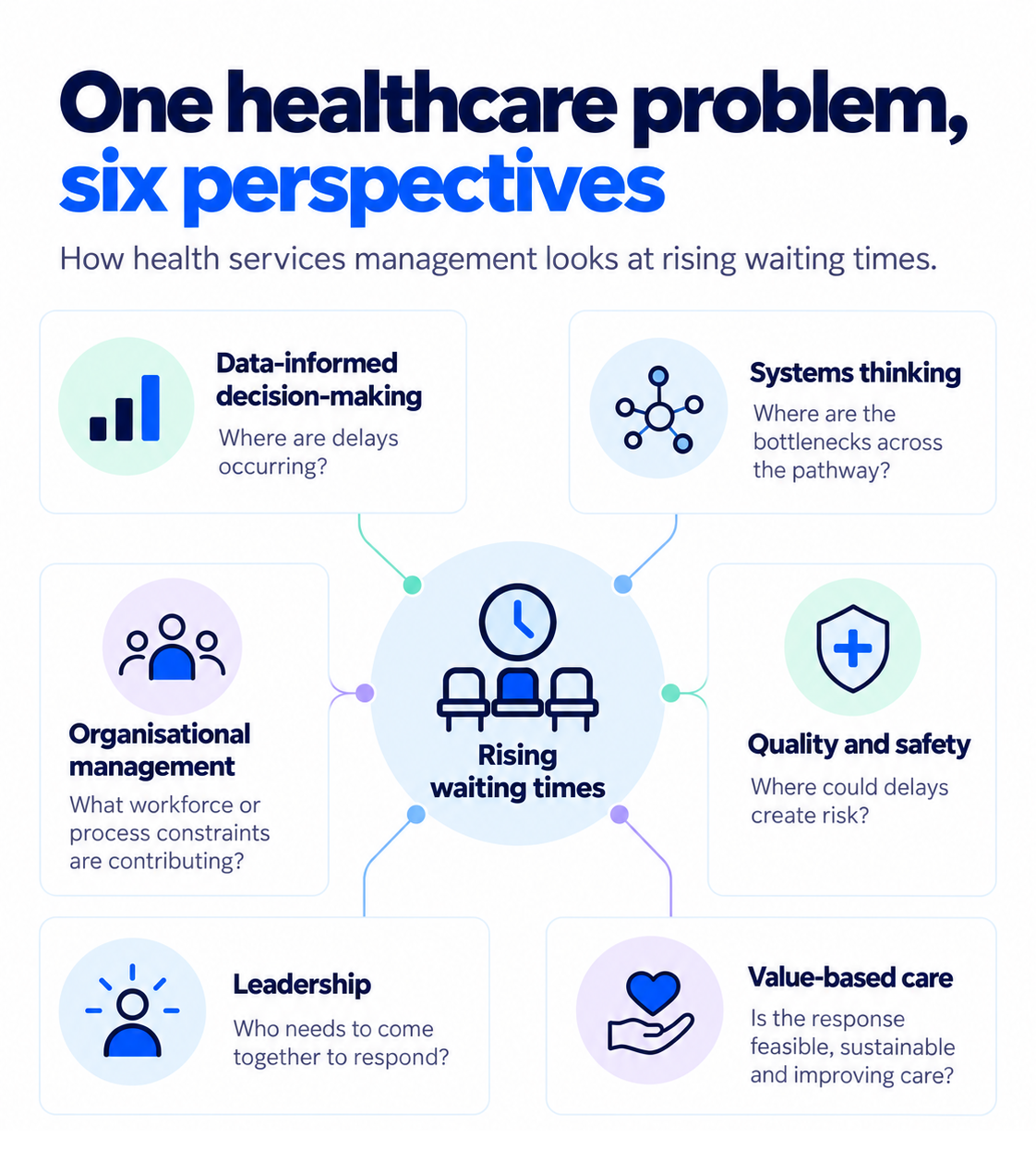
Take rising waiting times. Data can show where delays are occurring. Systems thinking can reveal bottlenecks elsewhere in the patient pathway. Organisational management can uncover workforce or process constraints, while a quality and safety perspective identifies the risks created by delay.
Leadership skills help bring teams together around a response, and value-based care helps determine whether the proposed solution is achievable, worthwhile and sustainable.
No single perspective tells the whole story. Health services management is about seeing the different dimensions of a complex problem and knowing how to bring them together.
The further you move in healthcare, the less often the answer sits in one place.
Moving into management doesn’t mean leaving your professional identity behind
Many health professionals move into management without setting out to become “a manager”. You might take responsibility for a clinical team, coordinate a program, lead an improvement project or become accountable for staffing, budgets or service performance.
Your clinical and professional experience remains one of your greatest strengths. But managing people, resources, services and change requires capabilities that clinical training alone may not provide.
You may want to lead a team or service, move into quality and safety, policy or planning, take responsibility for operations, or simply have more influence over how care is organised and delivered.
So the question is not:
Do I want to become a manager?
It is:
Do I want greater confidence and influence when taking responsibility for the people, services and systems around me?
Demand for these capabilities is growing. Jobs and Skills Australia projects employment in the broad category of Health and Welfare Services Managers to grow by 27.1% between 2025 and 2035, one of the strongest projected growth rates among management occupations.
27.1% projected employment growth to 2035
Health and Welfare Services Managers, Jobs and Skills Australia
This is a broad occupational category covering areas such as medical administration, nursing clinical leadership, primary health organisation management and the management of allied health and other health services. It describes a diverse field of work, not a single job title or career path.

See more of the system around you
Health services management is not about stepping away from health and social care. It is about learning to see more of it: the funding decision behind the service constraint, the organisational conditions behind the stalled strategy, the pattern behind the data, the contributing factors behind the incident and the trade-offs behind an improvement.
Together, the six core subjects in the UTS Online Master of Health Services Management build a set of capabilities that can move with you as your responsibilities and career evolve.
Because progressing in healthcare is not always about knowing more about your own part of the system. Sometimes it is about understanding how all the parts connect.
Frequently asked questions
Health services managers can draw on a mix of systems thinking, data analysis, organisational management, quality and safety, leadership and resource management. The combination required varies between roles, but these skills can help managers understand how services operate, make evidence-informed decisions, lead people, manage risk and improve service delivery.
The UTS Online Master of Health Services Management builds advanced capability across health systems, healthcare data and decision-making, organisational management, quality and safety, leadership and value-based care. Students can also develop deeper expertise through their chosen study pathway.
Clinical experience can provide a strong understanding of healthcare delivery, but management roles can require additional capability in areas such as organisational strategy, leadership, data, health systems, quality and safety and resource management. The pathway will depend on your existing qualifications, experience and the requirements of the role.
No. Health services management can involve professionals from clinical and non-clinical backgrounds, including health administration, programs, projects, policy, planning, analytics and other areas of health and social care. Different roles have different qualification and experience requirements.
Depending on your professional background and experience, health services management skills can support career pathways across service and operations management, clinical leadership, quality and safety, programs, projects, policy, planning and healthcare analytics.
Healthcare leadership focuses strongly on leading people, teams and change. Health services management is broader, bringing leadership together with areas such as organisational management, health systems, data, quality and safety, service planning and resource decision-making. In practice, many roles require both.
Recognise yourself in some of these challenges?
You may already be stepping into health services management, even if your job title doesn’t say it yet.
The UTS Online Master of Health Services Management can help you build the broader capability to take that next step, from understanding complex health systems and using data to make decisions to leading change, improving quality and safety, and making stronger decisions about services and resources.
Build on the experience you already have, deepen your expertise in the areas that matter to your career and prepare to take on bigger questions across health and social care.
Explore the UTS Online Master of Health Services Management.