Strategic communication careers in Australia: roles, salaries and skills

Strategic communication careers in Australia span corporate affairs, stakeholder engagement, internal communication, government and public affairs, and senior communication leadership. Roles exist across government, corporate, not-for-profit and consulting sectors, with typical salaries ranging from around $80,000 for mid-level roles to $150,000 or more in senior corporate affairs and leadership positions.
If that sounds broad, it's because it is. The harder question isn't whether strategic communication careers exist. It's whether your background qualifies you, what you'd need to build, and what a realistic first move actually looks like. That's what this guide is for.
Is strategic communication a good career path in Australia?
By the numbers, yes. According to Jobs and Skills Australia, Public Relations Professionals, the closest official occupational category to strategic communication, employ around 32,300 people nationally, with median full-time earnings of $2,046 a week, above the $1,852 all-occupation median. Jobs and Skills Australia also projects employment in the occupation to grow by around 12.3 per cent over the five years to May 2030, compared with 6.5 per cent growth across all occupations.
These two figures come from different Jobs and Skills Australia datasets, one measuring current size and earnings, the other forecasting growth, so they describe different things rather than conflicting. Both also describe an adjacent, official category rather than "strategic communicator" as a standalone title, since no single ANZSCO classification captures the full breadth of the field. But the underlying pattern holds across every data source examined for this guide: demand is broad, spans public and private sectors, and rewards people who can connect communication activity to organisational strategy rather than just executing tactics.
One advantage of the field is its breadth. Strategic communication capability is used across government, corporate, consulting and not-for-profit organisations, giving professionals opportunities to apply their skills across different sectors and organisational settings. This shift toward communication as a leadership capability is explored further in our piece on why communication leaders are in demand.
What actually separates strategic communication from PR, corporate communication and marketing?
These four terms get used almost interchangeably in job ads, which makes the field confusing to research. They overlap heavily in practice, but they emphasise different things.
| Area | Primary focus | Typical work |
| Strategic communication | Aligning all communication activity with organisational goals | Communication planning, stakeholder engagement, campaign strategy, research and evaluation |
| Corporate communication | Managing an organisation's overall voice, internally and externally | Reputation management, internal communication, risk and issues, executive communication |
| Public relations | Managing public perception and media relationships | Media liaison, publicity, reputation and brand positioning |
| Marketing communication | Driving audience action toward commercial outcomes | Campaigns, advertising, brand messaging, digital promotion |
Public relations tends to be the narrowest of the four, focused mainly on media relations and public perception. Strategic communication is broader. It includes PR, but extends into stakeholder engagement, behavioural insight, organisational strategy and long-term planning. Corporate communication sits close to strategic communication but leans more heavily into internal voice, reputation and risk. Marketing communication is more commercially driven, aimed at shaping audience behaviour toward a sale or conversion rather than an organisation's broader reputation or relationships.
In practice, most professionals move between these labels over a career. A media advisor becomes a stakeholder engagement manager. A marketing coordinator becomes a corporate affairs advisor. The boundaries matter less than the direction you're moving in: from executing single communication tasks toward planning communication that shapes organisational outcomes.
Five career paths in strategic communication
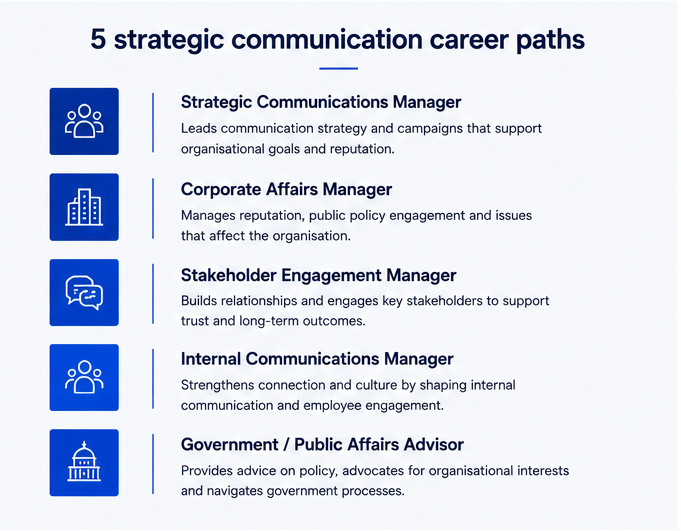
Job titles in this field aren't standardised. Two organisations can use "Communications Manager" to describe completely different scopes of work, and "Corporate Affairs Manager" in one company might be "Head of Reputation" in another. The five paths below represent genuinely different functions within strategic communication, chosen because they lead in different directions and draw on different strengths.
Strategic Communications Manager
What they do: A Strategic Communications Manager owns the link between organisational strategy and communication output. Rather than producing individual pieces of content, they plan how communication activity across channels supports business or organisational objectives, and they're usually accountable for measuring whether it worked.
Typical responsibilities: developing communication strategy and plans, briefing and coordinating specialist teams (media, digital, internal), advising senior leaders on communication risk and opportunity, and evaluating campaign or program performance against objectives.
Key skills: strategic planning, stakeholder mapping, research and evaluation, and the ability to translate business goals into communication activity.
Salary in Australia: salaries vary considerably by organisation, sector and level of responsibility. Glassdoor reports average pay of around $125,000 for Strategic Communications Managers in Australia, although the available sample is small and should be treated as indicative rather than a precise benchmark. Advertised salaries can also vary substantially depending on the scope and seniority of the role.
How to become one: this role is rarely a first job. Most Strategic Communications Managers move up from communications officer, advisor or marketing coordinator roles after building experience across multiple channels and demonstrating they can think beyond individual tasks to overall strategy.
Where it can lead: Head of Communications, Corporate Affairs Manager, or director-level communication leadership roles.
Corporate Affairs Manager
What they do: Corporate Affairs Managers manage the relationship between an organisation and the external parties that shape its reputation and licence to operate, including media, government, investors and industry bodies. The role blends strategic communication with elements of government relations and issues management.
Typical responsibilities: advising executives on reputational risk, managing media relationships, coordinating responses to sensitive issues, and building relationships with regulators, industry groups or government stakeholders.
Key skills: issues and crisis judgement, executive advisory skills, media strategy and political or regulatory literacy.
Salary in Australia: Corporate Communications Manager roles, a closely comparable job-ad title, typically range from around $135,000 to $150,000, based on advertised salaries reported by SEEK. No government occupation profile publishes earnings data specifically for Corporate Affairs Manager, so this figure is based on job-ad and aggregator sources rather than official labour statistics, and should be read as a general guide rather than a precise benchmark.
How to become one: this is typically a senior appointment, reached through several years in communications, PR, government relations or policy roles, often with direct exposure to crisis or issues management along the way.
Where it can lead: Head of Corporate Affairs, Director of Communications, or executive advisory roles reporting directly to a CEO or board.
Stakeholder Engagement Manager
What they do: Stakeholder Engagement Managers build and manage structured relationships with the groups affected by an organisation's decisions, whether that's local communities around an infrastructure project, government departments, industry partners or internal staff during major change.
Typical responsibilities: developing engagement strategies, running consultation processes, managing relationships with community or government representatives, and reporting on engagement outcomes to project or executive leadership.
Key skills: relationship management, conflict resolution, consultation design and the ability to translate community or stakeholder concerns into organisational action.
Salary in Australia: salaries vary significantly by sector, seniority and project scope. Comparable Stakeholder Manager roles have advertised salary benchmarks around $160,000 to $170,000 nationally, although individual Stakeholder Engagement Manager positions may sit above or below this range. Treat salary figures as indicative rather than fixed.
How to become one: common entry points include community engagement, project coordination or government liaison roles, particularly in infrastructure, energy, health or local government.
Where it can lead: Head of Engagement, Corporate Affairs Manager, or senior stakeholder roles on major government or infrastructure programs.
Internal Communications Manager
What they do: Internal Communications Managers lead communication to employees, covering everything from major organisational change and leadership messaging to day-to-day culture and engagement content. As organisations increasingly treat internal communication as a strategic function rather than an administrative one, this role has grown in seniority and scope.
Typical responsibilities: developing internal communication strategy, supporting change and transformation programs, advising leaders on how to communicate difficult or complex messages, and managing internal channels and platforms.
Key skills: change communication, executive ghostwriting and messaging, employee experience insight and channel strategy.
Salary in Australia: typical salaries range from around $101,000 to $140,000, based on the 25th to 75th percentile of reported pay (Glassdoor, March 2026). Other salary aggregators report national averages closer to $105,000, a meaningful gap that reflects differences in methodology and sample rather than a single agreed figure, so this range is best read as indicative rather than precise.
How to become one: frequently reached via HR, people and culture, or general communications officer roles, particularly for professionals who show strength in translating complex or sensitive organisational messages for a general employee audience. For a closer look at this kind of transition, see our guide on how to become a communications manager.
Where it can lead: Head of Internal Communications, Director of People and Culture Communications, or broader corporate affairs leadership.
Government and Public Affairs Advisor
What they do: Government and Public Affairs Advisors communicate policy and organisational positions to government, media and the public, typically within the public sector, regulated industries or organisations with significant government exposure.
Typical responsibilities: briefing ministers or senior officials, drafting policy communication and public statements, coordinating whole-of-government messaging, and managing communication during sensitive policy processes.
Key skills: policy literacy, political awareness, precise writing under scrutiny and the ability to manage competing stakeholder interests within government processes.
Salary in Australia: advertised Commonwealth government roles at the EL1 classification level have recently ranged from around $128,000 to $142,000, based on live job advertisements rather than a broader salary survey (SEEK job listings, 2026). State government pay bands vary by classification and jurisdiction.
How to become one: common pathways include policy roles, journalism or communications officer positions within government agencies. Jobs and Skills Australia data shows that Public Relations Professionals, the closest matching official occupation, are concentrated in New South Wales (36.3% of the workforce) and Victoria (28.1%).
Where it can lead: Corporate Affairs Manager, Director of Public Affairs, or senior policy advisory roles either within government or in organisations that deal heavily with government.
For a broader list of roles across the field, including public relations, media advisory and brand management positions, see our guide to top careers in strategic communication.
What skills do employers actually look for?
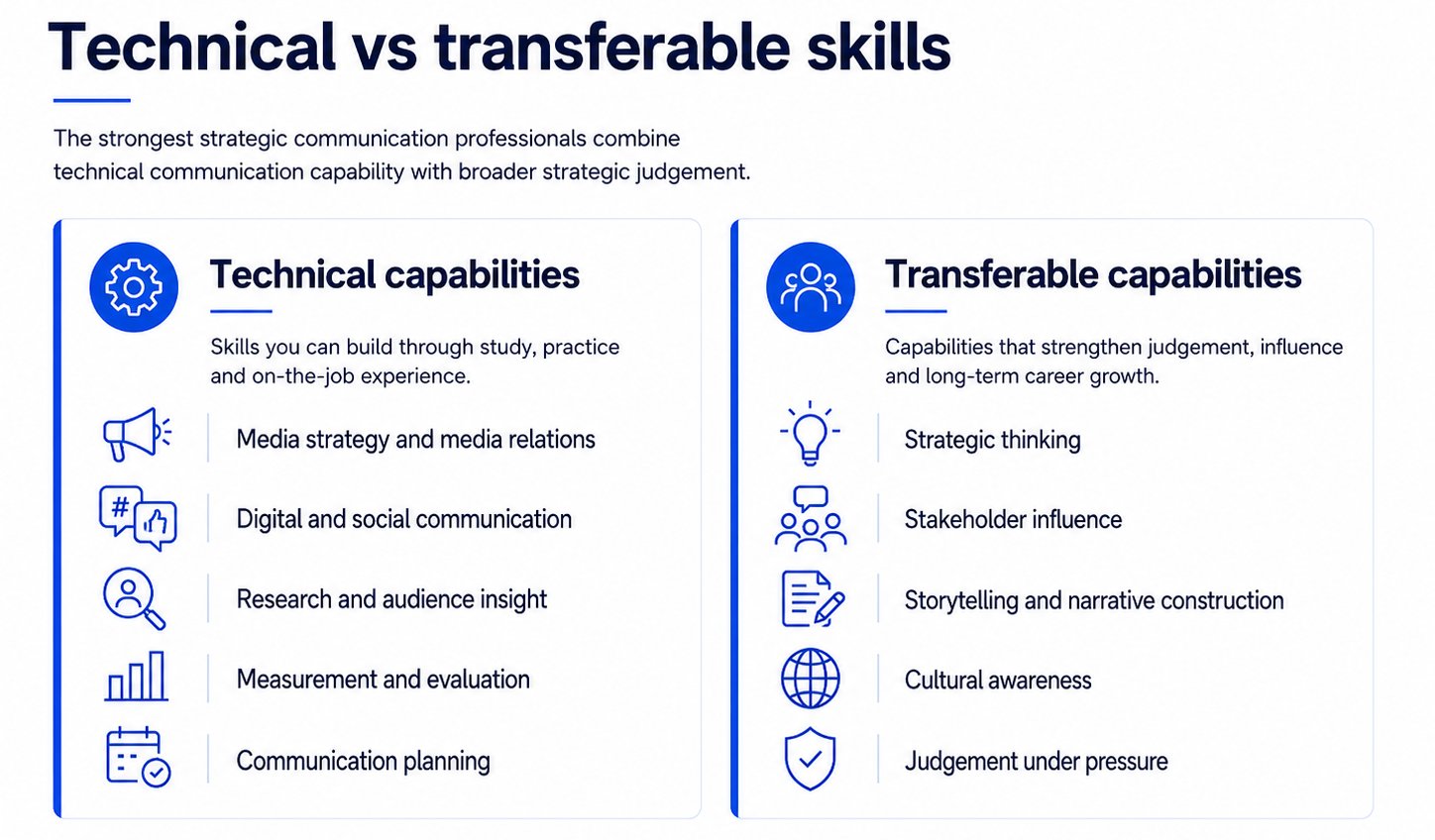
Job ads in this field tend to blur two very different kinds of capability: things you can be trained in relatively quickly, and things that take longer to build because they depend on judgement and experience.
Technical capabilities include media strategy and media relations, digital and social communication, research and audience insight, and measurement and evaluation. These are learnable through study, on-the-job exposure or short courses, and most employers expect them to develop over the first few years of a career.
Transferable capabilities include strategic thinking, stakeholder influence, storytelling and narrative construction, cultural awareness, and sound judgement under pressure, particularly during a crisis or sensitive issue. These are harder to teach directly. They're usually built through varied experience, exposure to different types of organisations and stakeholders, and time spent making judgement calls that didn't always go perfectly.
This distinction matters most for career switchers. If your current role hasn't given you much technical communication experience, that's a real but addressable gap. If it has given you strong stakeholder judgement, structured thinking or the ability to translate complexity for different audiences, you're closer to this field than the job titles alone might suggest.
Do you need a communication degree to work in strategic communications?
No, not universally, but the honest answer is more nuanced than a straight yes or no.
There's no single legal or licensing requirement to work in strategic communication in Australia. People enter the field from journalism, marketing, policy, law, project management and plenty of other backgrounds. Many senior practitioners build their careers primarily through experience, moving from adjacent roles into communication-focused ones over time.
That said, mid-level and senior roles often require demonstrated strategic capability and relevant experience. For career switchers, postgraduate study can provide a structured way to develop knowledge in areas such as stakeholder engagement, crisis communication and research methods that may not form part of their current role. It's also a practical option for people who want structured exposure to areas like stakeholder engagement, crisis communication or research methods that their current role doesn't offer.
The realistic picture: a communication degree isn't compulsory, but relevant study can help you build capability in areas you haven't yet had the opportunity to develop through work experience.
How to break into strategic communications: a realistic path
There's no single route into this field, but the professionals who make a successful transition tend to follow a recognisable pattern. This is what that generally looks like.
- Audit your transferable skills. Look honestly at what your current role has already taught you. Stakeholder management, writing under pressure, translating complexity, project coordination and public speaking all count, even if they weren't labelled "communications" in your job title.
- Build direct communication experience. Look for ways to take on communication-adjacent tasks in your current role: drafting internal updates, managing a stakeholder relationship, coordinating an event or campaign. Volunteering for a not-for-profit's communication needs is another common entry point.
- Develop a portfolio of real examples. Employers in this field want evidence, not just a description of interest. A handful of concrete examples of communication you've planned, written or delivered will do more than a general statement of enthusiasm.
- Understand how communication connects to organisational strategy. The gap between an executor and a strategist is usually the ability to explain why a piece of communication matters to the broader goals of the organisation, not just how it was produced.
- Build stakeholder and audience capability. Strategic communication is fundamentally about understanding different audiences and what moves them. Any experience engaging, consulting with or influencing a specific group of people is directly relevant.
- Gain exposure across different communication functions. Where possible, look for opportunities to work across internal and external communication, media and digital, or corporate and government contexts. Breadth is genuinely valued at the point where organisations are hiring for strategic rather than purely executional roles.
- Build professional networks. Strategic communication is a relationship-driven field. Industry events, professional associations and informal networks are common sources of both opportunities and mentorship for people making a transition.
- Consider relevant postgraduate study. For career switchers, structured study can provide a focused way to build strategic, research and stakeholder capabilities, particularly if your current role doesn't offer natural exposure to these areas.
None of these steps guarantees a particular job or salary outcome. Together, they reflect the pattern most successful transitions into this field actually follow.
How postgraduate study can support a strategic communication career
Postgraduate study won't guarantee a promotion or a specific job title. For a broader look at this question, see is postgraduate study worth it for experienced professionals. What it can do here is build the specific capabilities that separate strategic roles from executional ones, particularly for professionals whose current job hasn't given them the chance to practise strategic thinking, stakeholder engagement or crisis response directly.
| Career need | Relevant capability | Where it's developed | Career relevance |
| Moving from execution to strategy | Communication planning and strategic campaigns | Core subjects in strategic communication study | Supports the shift from producing content to shaping strategy |
| Managing sensitive issues or crises | Risk, issues and crisis communication | Core subjects in corporate communication study | Directly relevant to corporate affairs and senior communication roles |
| Working across diverse stakeholder groups | Stakeholder engagement | Core subjects in strategic and corporate communication | Relevant to almost every role profiled above |
| Communicating across cultures and contexts | Intercultural and international communication | Core subjects in strategic communication study | Increasingly relevant given how globally connected most organisations now are |
| Making a case for communication activity | Applied research and evaluation methods | Elective and core subjects depending on course | Builds the evidence base senior stakeholders expect |
These capability areas map most closely to genuine gaps identified earlier in this guide, particularly for professionals moving from execution-focused roles into more strategic ones, or from adjacent fields into communication for the first time.
Which UTS Online communication course fits your goals?
The right course depends on where you are now and what you want to build next.
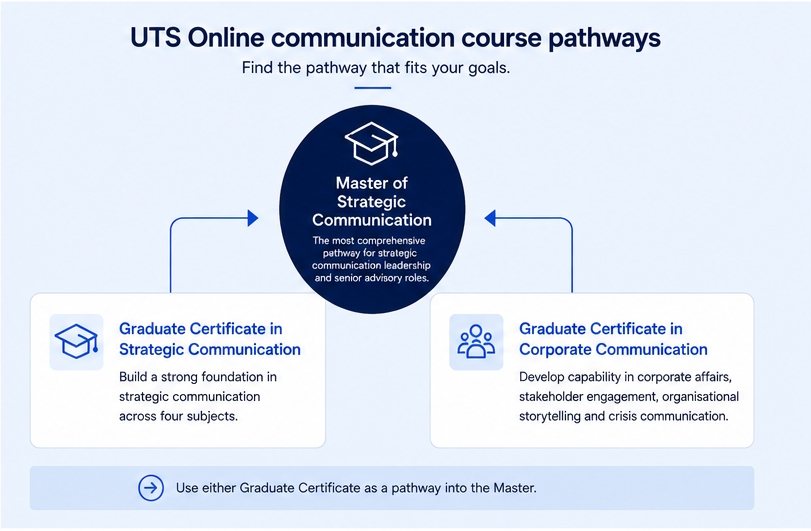
If you want to build broad strategic communication capability and prepare for senior, leadership or strategic advisory roles, the Master of Strategic Communication may be the best fit. It develops capability across stakeholder engagement, crisis communication, strategic campaigns, applied research and other areas of strategic communication practice.
If you want to build a foundation in strategic communication or transition into the field without committing to a full master’s, the Graduate Certificate in Strategic Communication offers a shorter, four-subject option. It can also provide a pathway into the Master of Strategic Communication.
If you want to focus more specifically on corporate affairs, stakeholder engagement, organisational storytelling and risk and crisis communication, the Graduate Certificate in Corporate Communication may be the closer fit, particularly if you’re interested in corporate affairs or stakeholder engagement roles.
Ready to build your next step in strategic communication? Explore UTS Online’s postgraduate communication courses or speak with a Student Enrolment Advisor to find the option that aligns with your experience and career goals.
Frequently asked questions
Public relations focuses mainly on media relations and public perception. Strategic communication is broader. It includes PR but extends into stakeholder engagement, organisational strategy and long-term communication planning aligned with an organisation's goals, not just its media profile.
No formal qualification is required industry-wide, and many professionals enter through experience in adjacent fields. Competitive mid-level and senior roles increasingly favour candidates with relevant study or demonstrated strategic experience, so a degree can help but isn't compulsory.
Salaries vary considerably by role, seniority, sector and location. Mid-level communication roles can sit below $100,000, while senior management and corporate affairs positions can reach $150,000 or more. Because strategic communication covers a broad range of job titles, salary figures should be treated as general benchmarks rather than fixed expectations.
Yes. Many professionals transition from marketing, policy, HR, project management or journalism by building direct communication experience, developing a portfolio of real examples and, in some cases, undertaking postgraduate study to build strategic and stakeholder capabilities more quickly.
It depends on your goals. For professionals aiming at senior, strategic or leadership-focused communication roles, a master's can build capabilities, such as stakeholder engagement, crisis communication and strategic planning, that are harder to develop through experience alone. It doesn't guarantee a specific job or promotion.
Government, corporate, not-for-profit and consulting organisations all employ strategic communication professionals, across sectors including health, infrastructure, energy, finance, education and the arts.
Employers look for a mix of technical capability, such as media strategy, digital communication and evaluation, and transferable capability, such as strategic thinking, stakeholder influence and sound judgement under pressure. The transferable skills are often the harder ones to build and the ones that most distinguish strategic roles from executional ones.
A Graduate Certificate is a shorter way to build foundational strategic or corporate communication capability, particularly useful for career switchers testing the field, and can lead into the Master's later. The Master's suits professionals ready to commit to a broader, more advanced qualification aimed at senior or leadership roles from the outset.