What is programmatic advertising? A beginner's guide for marketers

Someone opens a website. Before the page finishes loading, an auction has run, a decision has been made, and an ad appears — matched to that exact person, in that exact moment. No phone call. No insertion order. Technology did the work in milliseconds.
That's programmatic advertising, and it now sits behind the vast majority of digital ads we see every day. In Australia, internet advertising reached AUD $19.8 billion in FY26 — the strongest growth in four years, according to IAB Australia's Internet Advertising Revenue Report prepared by PwC — with programmatic channels driving the bulk of display and video transactions.
This guide explains what programmatic advertising actually means, how the buying process works, the technology involved, where it shows up and what marketers need to weigh up before using it. We'll also clear up one of the most common mix-ups in the industry: the difference between programmatic advertising and real-time bidding. And we'll keep returning to the idea that matters most — programmatic automates media buying, but it doesn't automate good marketing.
Programmatic advertising is the automated buying and selling of digital ad inventory using software, data and algorithms, rather than manual, one-to-one negotiation.
Programmatic advertising and real-time bidding (RTB) are not the same thing. RTB is one buying method among several, including private marketplaces, preferred deals and programmatic guaranteed arrangements.
The core technology — demand-side platforms (DSPs), supply-side platforms (SSPs) and ad exchanges — connects advertisers and publishers, but real ecosystems are often more layered than a simple diagram suggests.
Programmatic can offer scale, automation and flexible optimisation, but it doesn't guarantee lower costs, better return on investment or perfectly targeted reach. Strategy, data quality and oversight still do the heavy lifting.
Understanding programmatic helps marketers work more effectively with agencies and platforms, even if they never run a campaign themselves.
What is programmatic advertising?
Programmatic advertising is the automated buying and selling of digital advertising inventory using software, data and algorithms. Instead of negotiating every placement manually, advertisers use technology to identify opportunities and purchase impressions based on campaign criteria such as audience, budget and objective.
The key distinction: traditional media buying relies on people negotiating placements directly, publisher by publisher. Programmatic hands much of that process to technology, which can evaluate and act on opportunities far faster than any human team.
It's also worth remembering that programmatic isn't a single platform or ad format. It's a method — a way of buying advertising that sits underneath display banners, video, audio, streaming TV and more. Keeping that in mind clears up a lot of confusion later.
The numbers reflect how central it's become. In Australia, video advertising reached AUD $5.9 billion in FY26, growing 18.8% year on year, according to IAB Australia's Internet Advertising Revenue Report prepared by PwC. Connected TV now accounts for 60% of publisher video expenditure — up from 51% in FY25 — as Australian audiences continue shifting from linear TV to streaming. Programmatic sits at the centre of that growth, quietly becoming the default way digital media is bought and sold.
How does programmatic advertising work?
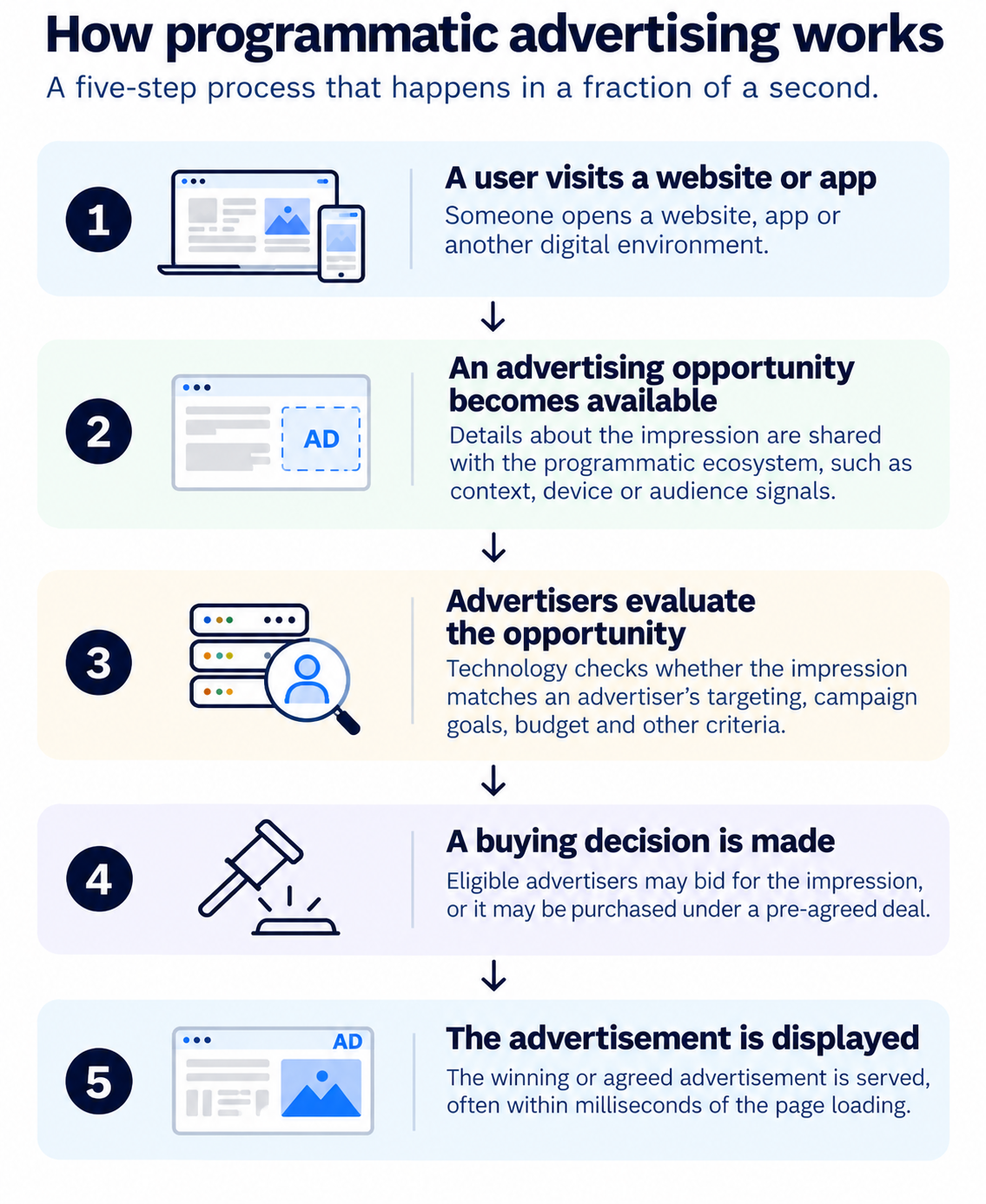
Programmatic advertising works through a five-step sequence that plays out in a fraction of a second.
- A user visits a digital property. Someone opens a website, app, streaming service or another environment that carries advertising inventory.
- An advertising opportunity becomes available. Details about that impression — such as context, device or audience signals — are passed into the programmatic ecosystem.
- Advertisers evaluate the opportunity. Technology checks whether the impression matches an advertiser's targeting, campaign goals, budget and other set criteria.
- A buying decision is made. Depending on the type of deal, eligible advertisers may bid for the impression, or it may be purchased under a pre-agreed arrangement.
- The ad is displayed. The winning or agreed advertisement is served, often within milliseconds of the page loading.
That's the simplified version, and deliberately so. You don't need an ad-tech engineering background to use programmatic marketing well. You need to understand the shape of the process so you can ask the right questions.
What technology is used in programmatic advertising?
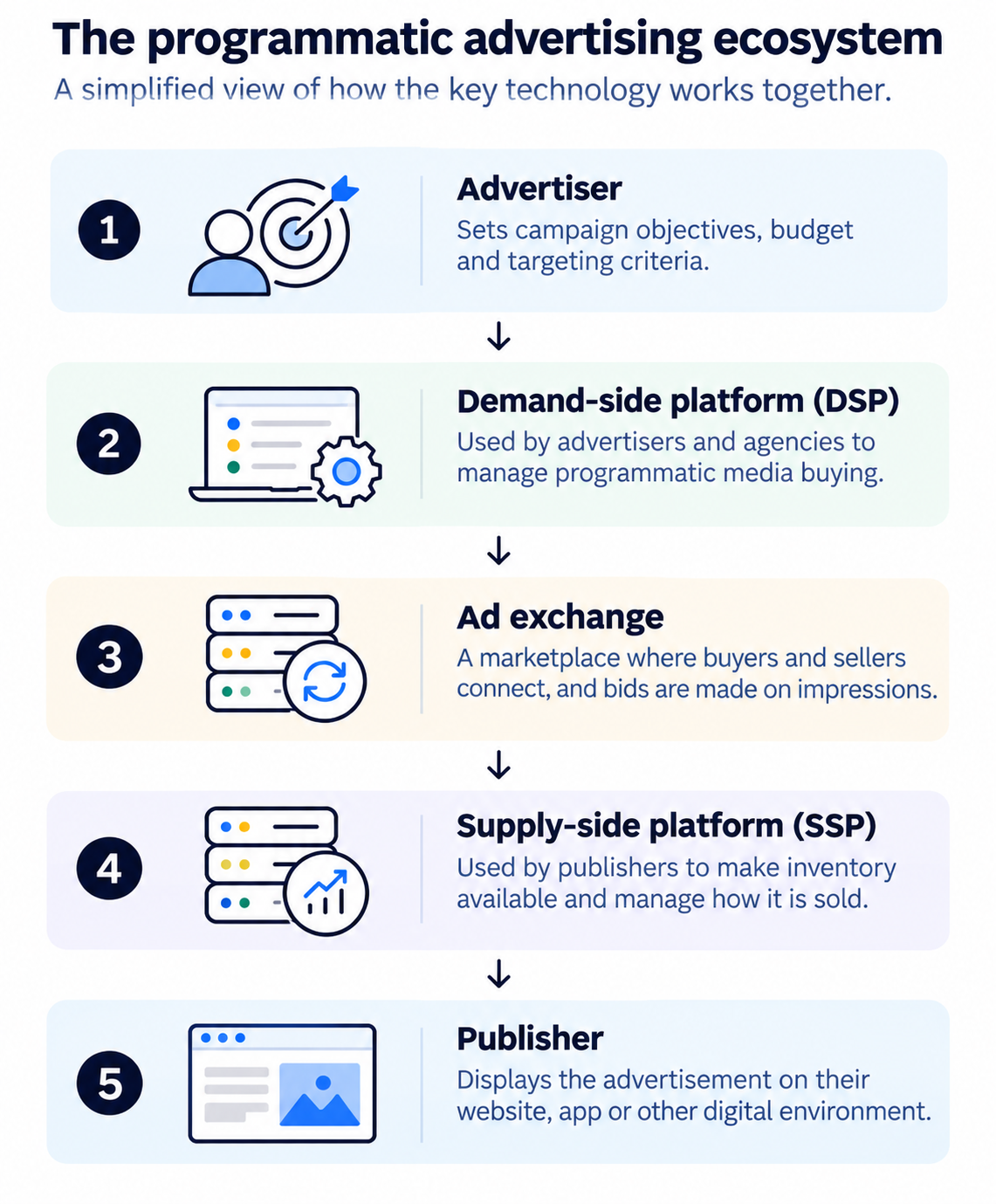
Three main components move the pieces: demand-side platforms, supply-side platforms and ad exchanges.
What is a demand-side platform (DSP)?
A DSP is the technology advertisers and agencies use to manage programmatic media buying across available inventory. It's where campaign criteria, budgets and targeting parameters are set.
What is a supply-side platform (SSP)?
An SSP is the technology publishers use to make their advertising inventory available and manage how it's sold — often across multiple potential buyers at once.
What is an ad exchange?
An ad exchange connects available inventory from the supply side with potential buyers on the demand side, functioning like a digital marketplace where opportunities and bids meet.
What role does data play?
Campaign decisions can draw on a range of signals — context, location, device type, first-party audience data and other permitted inputs — depending on what's available and what privacy rules allow.
A simplified flow looks like this: Advertiser → DSP → ad exchange → SSP → publisher. Treat that as a sketch, not a blueprint. Real programmatic ecosystems often involve additional intermediaries, data providers and verification layers.
Is programmatic advertising the same as real-time bidding?
No — and this is one of the most common misconceptions in digital advertising, so it's worth being direct about it.
Real-time bidding (RTB) is one way programmatic inventory can be bought — an auction-based method where eligible buyers compete for an impression as it becomes available. Programmatic advertising is the broader category that RTB sits inside. Some programmatic transactions happen through real-time auctions. Others use pre-negotiated or guaranteed arrangements where price and placement are agreed in advance, and technology automates the delivery.
Treating "programmatic" and "RTB" as interchangeable glosses over how varied modern media buying actually is.
What are the main types of programmatic advertising deals?
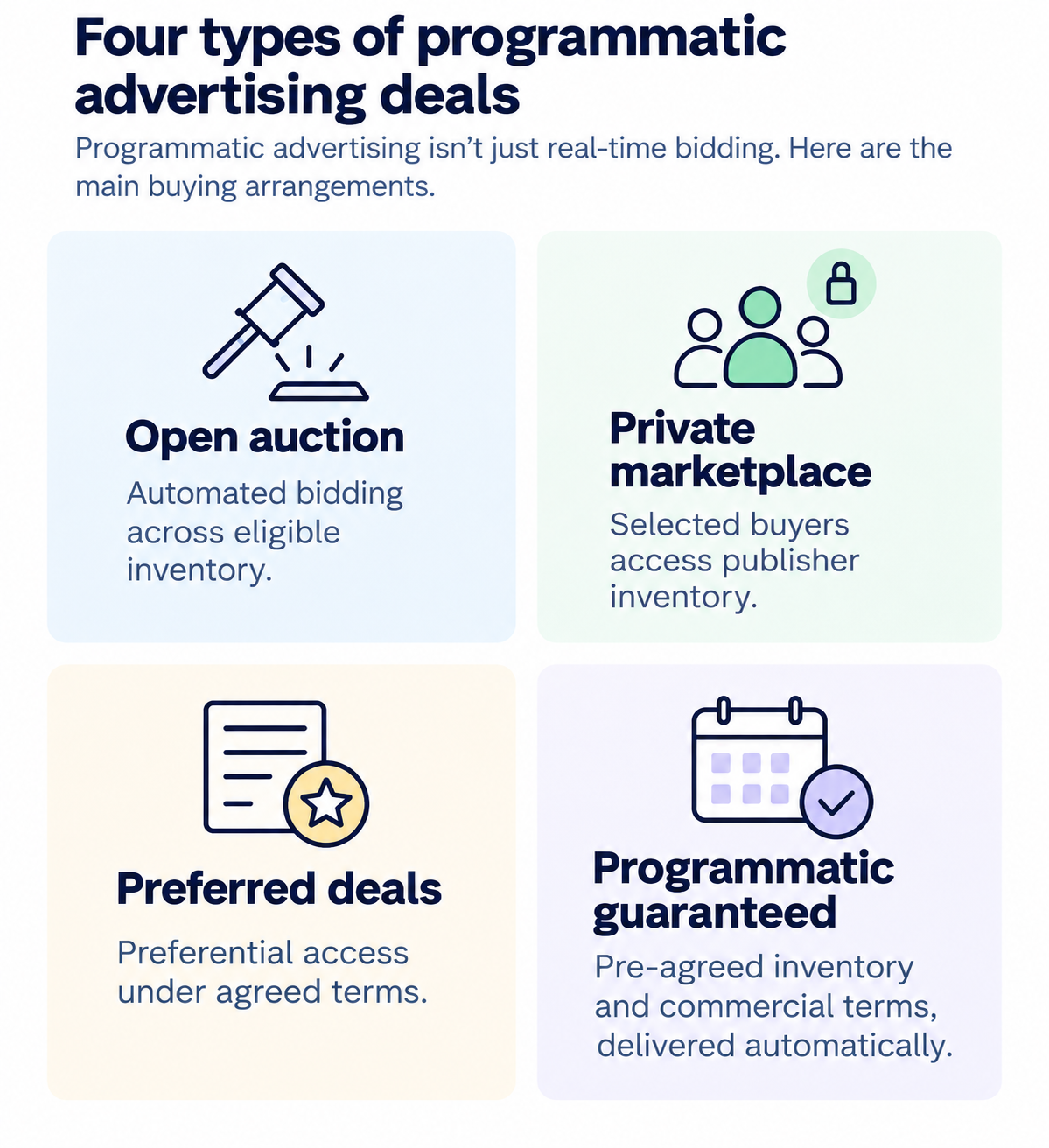
Programmatic buying isn't one-size-fits-all. Four approaches cover most of the landscape.
- Open auction / real-time bidding. Inventory is made available to eligible buyers, who compete for impressions through automated bidding.
- Private marketplace (PMP). Selected advertisers access inventory from particular publishers, usually with more control over placement and audience quality.
- Preferred deals. An advertiser gets preferential access to inventory at agreed conditions before it reaches the broader marketplace.
- Programmatic guaranteed. Advertiser and publisher agree on inventory and commercial terms upfront, while technology automates delivery and the transaction.
Terminology shifts slightly between platforms, but these four categories give marketers a solid working map.
Where do programmatic ads appear?
Programmatic is often mistaken for display banners alone. In reality, it spans a much wider set of formats and environments — and the mix is shifting fast.
Connected TV is a good example. As more Australians move from linear TV to streaming, CTV has become one of the fastest-growing environments for programmatic advertising. In FY26, connected TV represented 60% of publisher video expenditure in Australia, up from 51% the year prior, according to IAB Australia's Internet Advertising Revenue Report. Social video was the standout growth format, up 29.5% year on year to AUD $2.4 billion — now accounting for 41% of all video spend. According to IAB Australia's Video Advertising State of the Nation report, digital video advertising across all screens has become a significant or regular part of marketing activity for 92% of Australian advertisers surveyed.
Today, programmatic can reach audiences across:
- Display advertising
- Online video
- Mobile and in-app advertising
- Connected TV and streaming
- Digital audio
- Digital out-of-home
- Native advertising
What's actually available to a given campaign depends on the platforms, publishers, markets and setup involved. It's always worth checking availability at the planning stage rather than assuming it.
Programmatic advertising example: what does it look like in practice?
Picture an Australian retailer trying to reach people actively researching home renovations. Instead of calling a publisher and negotiating a banner placement, the marketing team opens their DSP, defines an audience — homeowners aged 30–55 in Sydney and Melbourne, browsing content related to kitchens, flooring and interior design — and sets a daily budget with a target cost per click.
From there, the platform does the heavy lifting. Every time an eligible impression becomes available across news sites, lifestyle publications and home improvement content, the DSP evaluates it against those criteria in milliseconds and decides whether to bid, and at what price.
A week in, the marketer logs back in to review performance. Video placements on home improvement content are driving strong engagement. Display ads on a general news site are burning through budget with little to show for it. They pause the underperforming placements, shift the budget toward what's working and update the audience targeting to focus on people who've already visited their product pages.
That's programmatic in practice — not a set-and-forget system, but a live feedback loop where data informs decisions and decisions improve results.
And none of it happens on autopilot. Someone still decided who to target, briefed the creative team, set the budget guardrails and defined which environments counted as brand-safe. The platform executed fast — but the marketer still had to think. That distinction matters more than ever as programmatic tools become more powerful.
What are the benefits of programmatic advertising?
Used well, programmatic marketing offers some real practical advantages:
- Scale. Access to inventory across many publishers and digital environments at once.
- Automation. Less manual legwork in buying and managing individual placements.
- Audience and contextual targeting. Campaigns can be configured around relevant signals, within the limits of available data and privacy rules.
- Campaign optimisation. Live performance data can inform changes to targeting, bidding, creative and budget allocation.
- Measurement. Platforms often provide granular reporting across campaigns and placements.
- Flexibility. Media buying can typically be adjusted faster than traditional, manually negotiated placements.
None of this means programmatic automatically delivers lower costs or better results. Outcomes depend heavily on strategy, data quality and how the campaign is actually managed.

What are the challenges of programmatic advertising?
Like any powerful tool, programmatic comes with real trade-offs — and these are worth understanding before you spend a dollar.
Complexity. Platforms, publishers, data providers and jargon can be genuinely hard to navigate when you're starting out.
Transparency. Knowing where budget actually goes, what fees apply and where ads end up requires active oversight. The World Federation of Advertisers has consistently highlighted supply chain transparency as a core governance concern for programmatic buyers.
Brand suitability. Automated buying means marketers need controls in place around which environments their ads appear in.
Ad fraud and invalid traffic. This is a real issue for any programmatic buyer. IAB Australia's Digital Ad Fraud Handbook identifies invalid traffic as an ongoing risk in open programmatic environments — and it's a problem that doesn't manage itself. Verification tools from providers like DoubleVerify and Integral Ad Science are widely used, but verification is something marketers need to actively manage, not treat as optional.
Viewability. Not all served impressions are actually seen. Industry standards define a display ad as viewable when at least 50% of its pixels are in view for one continuous second — but actual rates vary significantly by format, environment and buying approach. It's worth checking current benchmarks from verification providers, as rates shift with inventory mix and buying behaviour.
Measurement complexity. IAB Australia's Future of Measurement review, released in September 2026, found that while Australian marketers feel reasonably confident assessing individual channels, confidence falls away when it comes to understanding how advertising collectively drives business outcomes. The central finding: the constraint is data quality and standardisation, not a shortage of measurement methods.
Privacy. Targeting and measurement must stay within current privacy requirements and platform policies.
Data quality. Automation is only as useful as the objectives, data and parameters feeding it.
The short version: automation handles execution. Strategic oversight still has to sit behind it.
How is privacy changing programmatic advertising?
The privacy landscape underpinning programmatic marketing continues to shift, and some older assumptions no longer hold.
Google stepped back from its earlier plan to deprecate third-party cookies in Chrome in favour of Privacy Sandbox alternatives. In 2025, Google confirmed it would retire most Privacy Sandbox technologies while continuing to support a smaller set of tools. The industry-wide "cookies are disappearing" narrative is now more nuanced than it was a few years ago — and marketers shouldn't assume a single, uniform outcome across all browsers and platforms.
On the regulatory side, Australia's privacy settings are also evolving. The Office of the Australian Information Commissioner released an exposure draft of the Privacy (Children's Online Privacy) Code in early 2026, proposing tighter limits on direct marketing to children, along with age assurance requirements and privacy impact assessments. It remains in draft at the time of writing, but it's a useful signal that audience targeting and data decisions increasingly need proper governance — not just technical configuration.
The broader direction of travel is clear: stronger reliance on first-party data (information a business collects directly from its own customers), contextual signals (targeting based on content environment rather than individual identity) and privacy-preserving measurement approaches. IAB Australia's Future of Measurement review flags that data clean rooms are frequently nominated as a solution for privacy-safe data collaboration — but remain among the least realised in practice. Given how quickly this space moves, it's worth checking current guidance from the OAIC and IAB Australia before locking in a data strategy.
What role does AI play in programmatic advertising?
Algorithmic decision-making has underpinned programmatic media buying for years. What's changed is how much more AI can now do within that process:
- Audience analysis
- Bidding and optimisation
- Creative variation and personalisation
- Campaign forecasting
- Anomaly detection
- Measurement and performance analysis
AI is expanding what can be automated. But it hasn't removed the need for human judgement. Marketers still need to understand their objectives, their customers, their creative strategy, their brand, their privacy obligations and the commercial trade-offs involved. AI can process signals faster than any team. It can't decide what a brand should stand for. IAB Australia's Future of Measurement review also notes that as buying becomes more agentic, AI raises new questions about what evidence machines can rely on — a challenge the industry is only beginning to work through.

What role does AI play in programmatic advertising?
Algorithmic decision-making has underpinned programmatic media buying for years. What's changed is how much more AI can now do within that process:
- Audience analysis
- Bidding and optimisation
- Creative variation and personalisation
- Campaign forecasting
- Anomaly detection
- Measurement and performance analysis
AI is expanding what can be automated. But it hasn't removed the need for human judgement. Marketers still need to understand their objectives, their customers, their creative strategy, their brand, their privacy obligations and the commercial trade-offs involved. AI can process signals faster than any team. It can't decide what a brand should stand for. IAB Australia's Future of Measurement review also notes that as buying becomes more agentic, AI raises new questions about what evidence machines can rely on — a challenge the industry is only beginning to work through.
Programmatic advertising vs paid social: what's the difference?
Platforms like Meta, LinkedIn and TikTok automate large parts of ad delivery too, but paid social campaigns generally run within each platform's own closed ecosystem. Programmatic media buying, by contrast, can span multiple publishers and environments outside any single platform.
The practical distinction matters more than the technical debate over whether every automated ad system "counts" as programmatic. For a marketer, the real question is where you need reach and which approach gets you there.
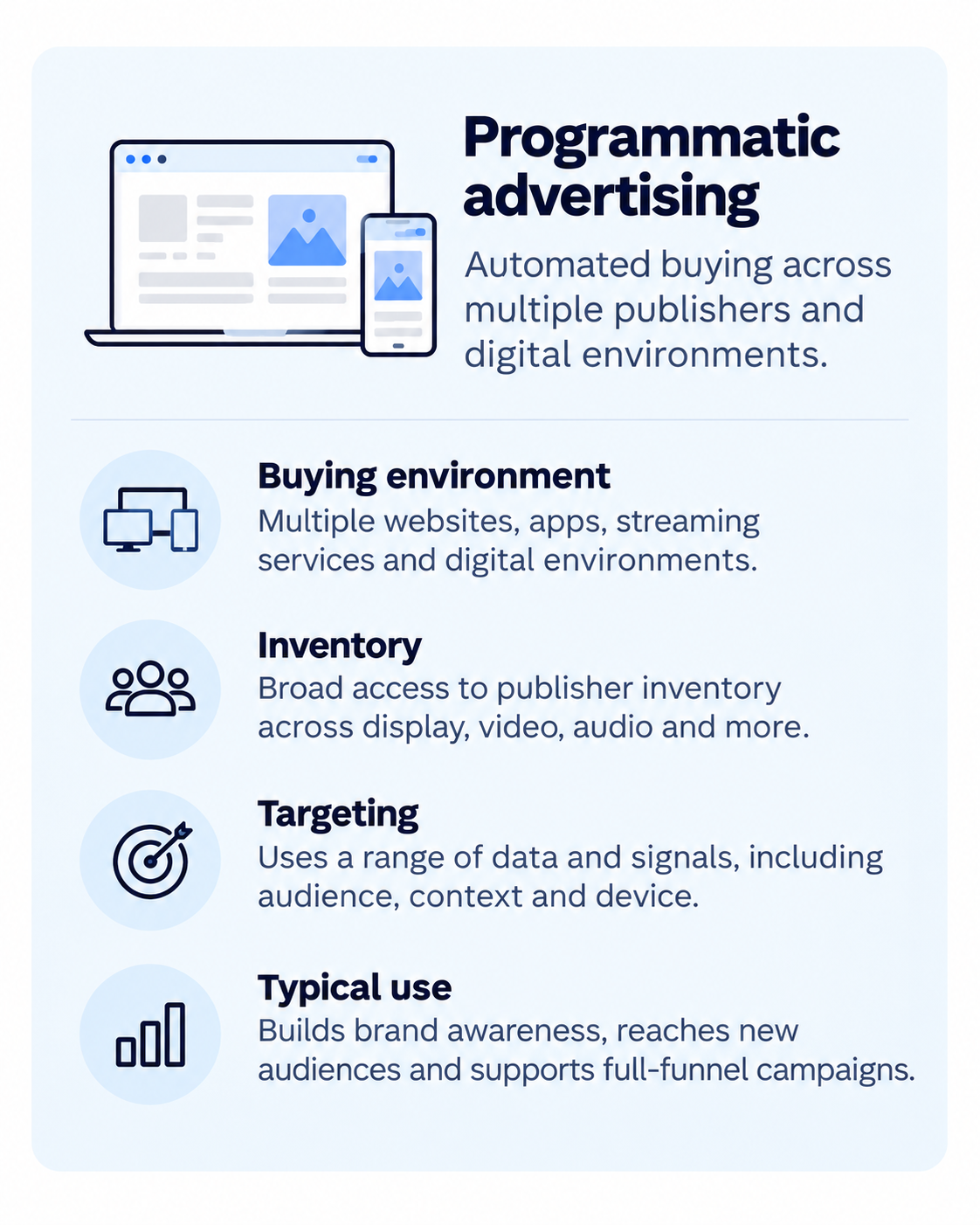
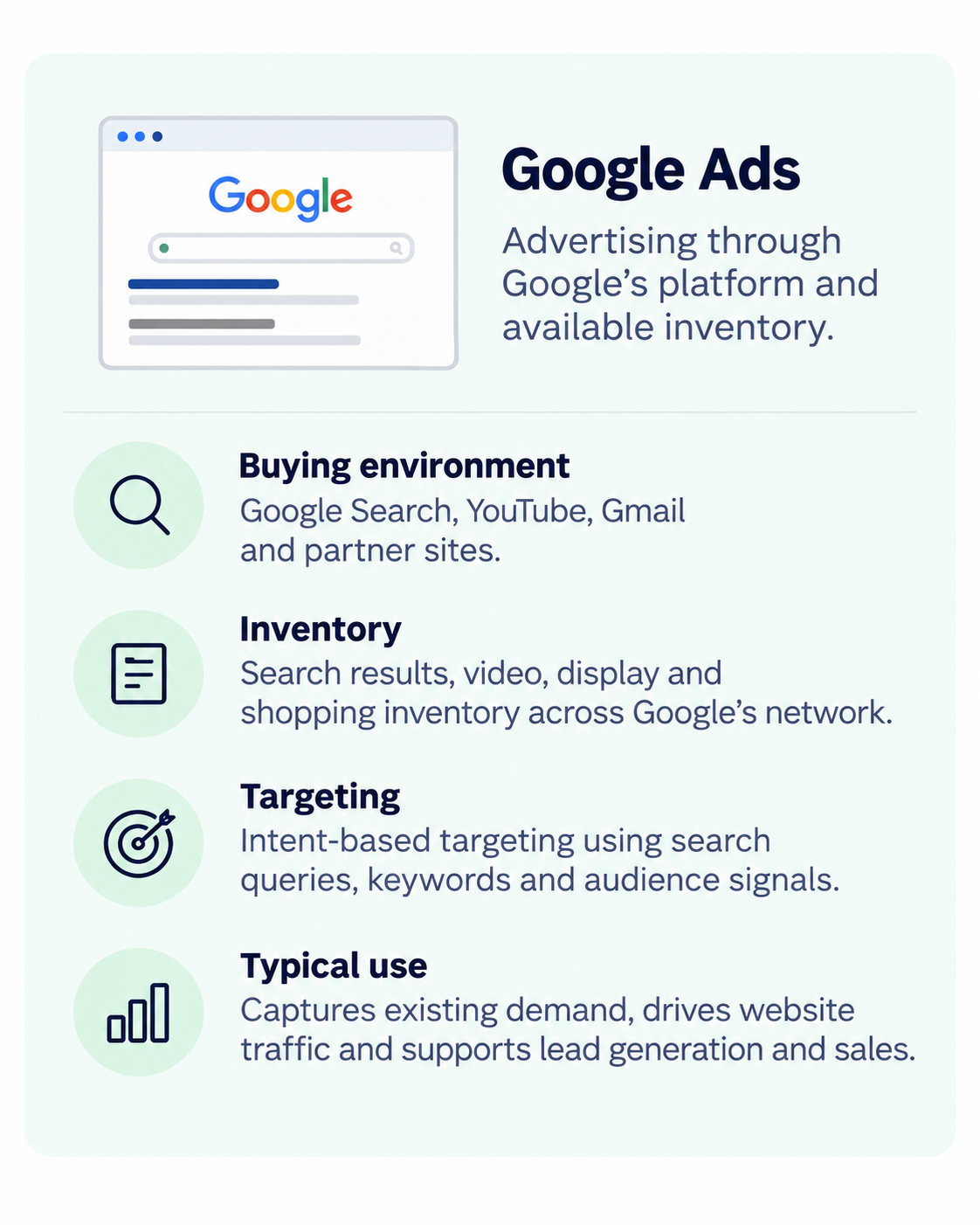
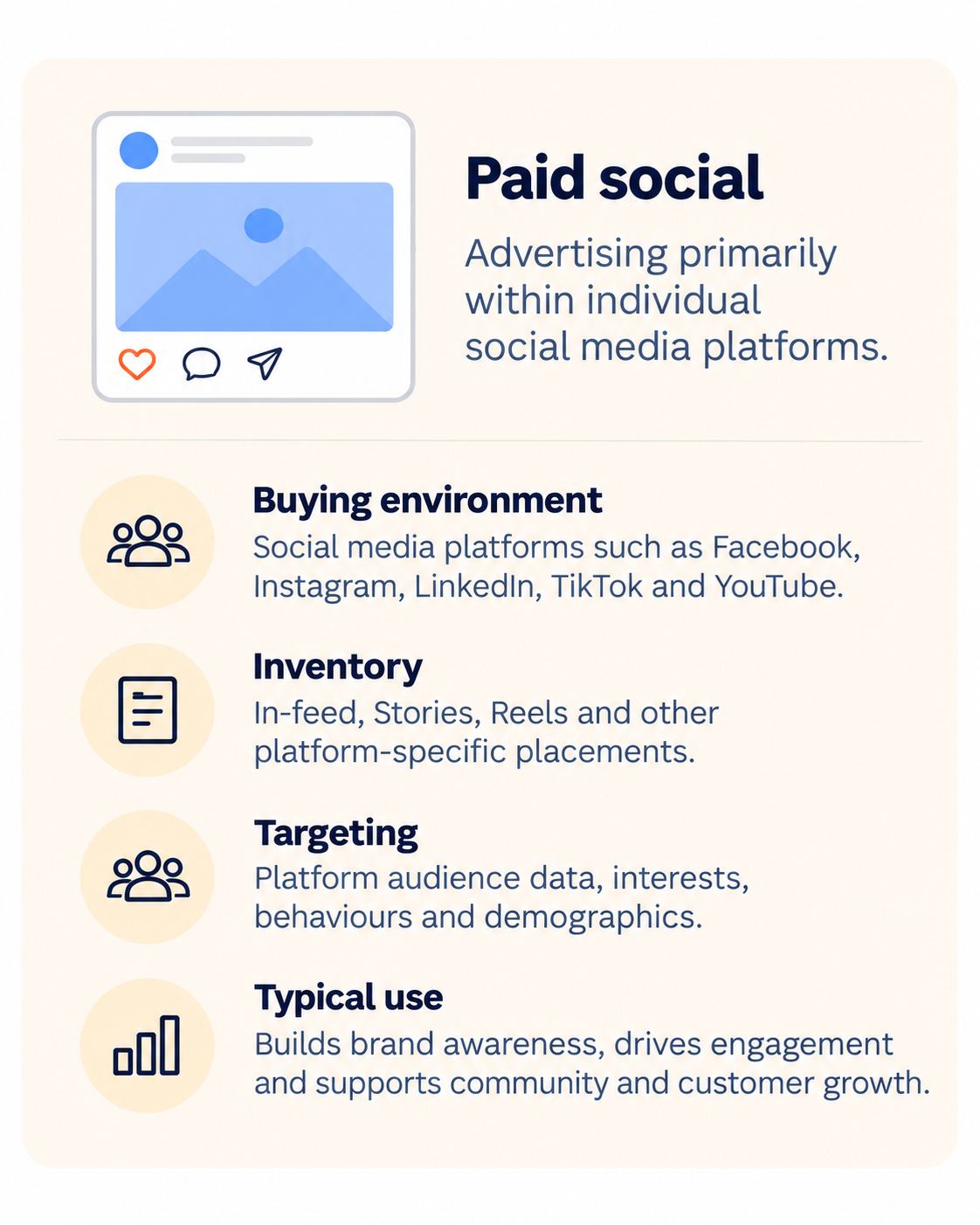
Think of these as overlapping tools rather than strict competitors. Many digital strategies use all three, depending on the objective.
Do you need a programmatic advertising agency?
Not necessarily — and the right answer depends on your situation. Businesses generally take one of a few paths:
- Managing programmatic activity internally, with in-house expertise
- Working directly with technology platforms
- Engaging a media or programmatic advertising agency
- Blending internal capability with external specialist support
A programmatic advertising agency can bring media strategy expertise, platform management, optimisation know-how and access to specialist technology that would otherwise take time to build internally. Whether that's worth it depends on your campaign scale, internal capability, budget, data maturity and overall complexity. There's no universal rule — just a set of honest questions worth asking before deciding.
What should marketers understand before using programmatic advertising?
Before diving in, clear answers to these questions will set any campaign up more effectively:
- What outcome are we actually trying to achieve: awareness, consideration, acquisition or something else?
- Who are we trying to reach?
- What data can we use responsibly?
- Where should our brand appear, and just as importantly, where should it not?
- How will we measure success?
- What does the technology or agency actually charge, and what's included?
- Who's responsible for ongoing optimisation and governance?
Answering these turns programmatic from a buzzword into a genuinely useful tool.
Is programmatic advertising worth learning?
Yes, for most marketers working in digital channels today. You don't need to become a programmatic trader to benefit from understanding how the ecosystem works. Grasping the fundamentals helps you work more effectively with agencies and specialists, interrogate campaign recommendations with confidence, understand where media investment is actually going and connect media decisions back to broader marketing strategy.
Building broader digital marketing capability
Programmatic advertising is one piece of a much larger digital marketing picture, one that increasingly blends strategy, data, technology and customer behaviour. For professionals wanting to deepen that broader capability, the Graduate Certificate in Digital Marketing from UTS Online is built around exactly this kind of thinking.
The course covers capabilities that map directly to what you've read here. Data-Driven Marketing connects to using campaign performance data to inform decisions — the same loop a marketer runs when reviewing programmatic results and reallocating budget. Digital Customer Behaviour relates to understanding audiences deeply enough to target them well, not just technically but strategically. And Omnichannel Marketing Strategy looks at how different digital touchpoints — programmatic display, social, search, CTV — work together rather than in isolation.
This course won't train you to operate a specific DSP. What it will do is sharpen the judgement behind every media decision you make, programmatic or otherwise.
Automation handles the buying. You still handle the thinking.
Programmatic advertising uses technology to automate how digital ad inventory gets bought and sold, from open auctions through to guaranteed deals. But automation doesn't replace the human decisions that actually determine whether a campaign works: who you're targeting, what you're saying, how you're measuring success and where your brand should and shouldn't show up.
For marketers, the real value isn't mastering every acronym in the ad-tech stack. It's understanding what the technology can do, where its limits sit and how it fits into a wider marketing strategy. If you're ready to build that kind of thinking further, explore the Graduate Certificate in Digital Marketing at UTS Online.
Frequently asked questions
Costs vary depending on the platform, deal type and campaign scale. Open auctions can offer flexible entry points, while private marketplaces and programmatic guaranteed deals often involve higher minimum commitments. There's no fixed price point — budgets should be planned around campaign goals, not assumptions about cost.
No. Programmatic can support more precise targeting and flexible optimisation, but outcomes depend on strategy, data quality and execution. It doesn't automatically reduce costs, boost ROI or eliminate wasted spend.
First-party data is information a business collects directly from its own customers or audience. Contextual signals relate to the content or environment an ad appears in, rather than the individual viewing it. Cookies and other identifiers are technical mechanisms historically used to track user activity across sites, and their availability and rules vary by browser and platform.
Yes. Many DSPs are accessible directly, though managing campaigns well still requires time, data literacy and ongoing attention. Smaller businesses sometimes start self-managed and bring in agency support as campaigns scale.
No. Real-time bidding is one method among several, alongside private marketplaces, preferred deals and programmatic guaranteed arrangements, each offering different levels of control and predictability.